This pancocojams post presents an excerpt of a Wikipedia article about the San people of Southern Africa.
This post also presents an excerpt of a bradshaw foundation article about San traditional healing dances as shown in their rock art.
The portion about the San healing dances is presented along with my question about whether those dances are a source (or the main source) for the circular, spinning dances that are done by members of many Southern Africa's Zionist Christian churches.
The content of this post is presented for historical, religious, and cultural purposes.
All copyrights remain with their owners.
Thanks to all those who are quoted in this post. Thanks also to the publisher of the video on YouTube that is embedded in this post. -snip- This pancocojams post is part of an ongoing pancocojams series about religion in Africa.
**** DISCLAIMER I'm an African American who knows very little about any Black cultures (or any other cultures) outside of the United States. However, I'm very interested in learning about other cultures, particularly about Black cultures throughout the world.
In 2016 I happened to come across YouTube videos of Southern African Zionist Christian church members walking and spinning in circles. Click http://pancocojams.blogspot.com/2016/02/south-african-isikhalanga-wafa-wafa.html for a 2016 pancocojams post that showcases YouTube videos of those dances (One of those videos is of a church in the United Kingdom which presumably was started by people of Southern African descent. Some of those videos use the words "Wafa wafa" in their title while some other titles for these videos include the word "isikhalanga". I think that word is used as a referent for those circular religious dances.
Here's a statement that I wrote in that 2016 pancocojams post: " The isikhalanga circular movement is somewhat similar to the 19th century (if not older) African American religious shouts. However, the videos of depictions of shouts that I've watched don't include the individual spinning that appears to be one of the key signatures of isikhalanga. That isikhalanga spinning movement reminds a little of the Sufi "whirling dervishes". That spinning also reminds me of the spinning movements of some traditional Igbo Nigerian masqueraders. This South African spinning movement also reminds me of the "wheel and turn" movements in Jamaican Kumina dancing."
My interest in these religious dances was recently revived when I again happened upon some YouTube videos of Southern African Zionists and my online search for information about those dances led me to the article about San healing dances that is included in this 2022 pancocojams post.
Here's an example of a YouTube video of the Southern African Zionist dancing that I'm referring to (I think this video is from Zimbabwe.)
Spepa (Jimila kubekwa ilitshe likamkhululi.
Trevor Ncube Oct 3, 2018
-snip- I sincerely apologize for my ignorance about these subjects and I mean no disrespect with my inquiries about the sources for these Zionist dances, their referents, and their religious and cultural meanings.
I would greatly appreciate any information and corrections about these subjects.
The San peoples (also Saan), or Bushmen,[1] are members of
various Khoe, Tuu, or Kxʼa-speaking indigenous hunter-gatherer cultures that
are the first cultures of Southern Africa, and whose territories span Botswana,
Namibia, Angola, Zambia, Zimbabwe, Lesotho[2] and South Africa. In 2017,
Botswana was home to approximately 63,500 San people, which is roughly 2.8% of
the country's population, making it the country with the highest population of
San people.[3]
[…]
Names
The endonyms used by San themselves refer to their
individual nations, including the ǃKung (ǃXuun) (subdivisions ǂKxʼaoǁʼae
(Auen), Juǀʼhoan, etc.) the Tuu (subdivisions ǀXam, Nusan (Nǀu), ǂKhomani,
etc.) and Tshu–Khwe groups such as the Khwe (Khoi, Kxoe), Haiǁom, Naro, Tsoa,
Gǁana (Gana) and Gǀui (ǀGwi).[12][13][14][15][16] Representatives of San
peoples in 2003 stated their preference of the use of such individual group
names where possible over the use of the collective term San.[17]
Both designations "Bushmen" and "San"
are exonyms in origin, but San had been widely adopted as an endonym by the
late 1990s. "San" originates as a pejorative Khoekhoe appellation for
foragers without cattle or other wealth, from a root saa "picking up from
the ground" + plural -n in the Haiǁom dialect.[18][19] The term Bushmen,
from 17th-century Dutch Bosjesmans, is still widely used by others and to
self-identify, but in some instances the term has also been described as
pejorative.[14][20][21][22]
Adoption of the Khoekhoe term San in Western anthropology
dates to the 1970s, and this remains the standard term in English-language
ethnographic literature, although some authors have later switched back to
Bushmen.[4][23] The compound Khoisan, used to refer to the pastoralist Khoi and
the foraging San collectively, was coined by Leonhard Schulze in the 1920s and
popularised by Isaac Schapera in 1930, and anthropological use of San was
detached from the compound Khoisan,[24] as it has been reported that the exonym
San is perceived as a pejorative in parts of the central Kalahari.[20] By the
late 1990s, the term San was in general use by the people themselves.[25] The
adoption of the term was preceded by a number of meetings held in the 1990s
where delegates debated on the adoption of a collective term.[26] These
meetings included the Common Access to Development Conference organised by the
Government of Botswana held in Gaborone in 1993,[15] the 1996 inaugural Annual
General Meeting of the Working Group of Indigenous Minorities in Southern
Africa (WIMSA) held in Namibia,[27] and a 1997 conference in Cape Town on
"Khoisan Identities and Cultural Heritage" organised by the
University of the Western Cape.[28] The term San is now standard in South
African, and used officially in the blazon of the national coat-of-arms. The
"South African San Council" representing San communities in South
Africa was established as part of WIMSA in 2001.[29][30] "Bushmen" is
now considered derogatory by many South Africans,[20][22][31] to the point
where, in 2008, use of boesman (the modern Afrikaans equivalent of
"Bushman") in the Die Burger newspaper was brought before the
Equality Court, which however ruled that the mere use of the term cannot be
taken as derogatory, after the San Council had testified that it had no
objection to its use in a positive context.[32]
The term Basarwa (singular Mosarwa) is used
for the San collectively in Botswana.[33][34][35] The term is a Bantu (Tswana)
word meaning "those who do not rear cattle".[36] Use of the mo/ba-
noun class indicates "people who are accepted", as opposed to the use
of Masarwa, an older variant which is now considered offensive.[28][37]
In Angola they are sometimes referred to as mucancalas,[38]
or bosquímanos (a Portuguese adaptation of the Dutch term for
"Bushmen"). The terms Amasili and Batwa are sometimes
used for them in Zimbabwe.[28] The San are also referred to as Batwa by
Xhosa people and Baroa by Sotho people.[39] The Bantu term Batwa
refers to any foraging tribesmen and as such overlaps with the terminology used
for the "Pygmoid" Southern Twa of South-Central Africa."...
In association with the Rock Art Research Institute, University of the Witwatersrand in Johannesburg, South Africa and The African Rock Art Digital Archive [no publishing date given; retrieved on January 15, 2022]
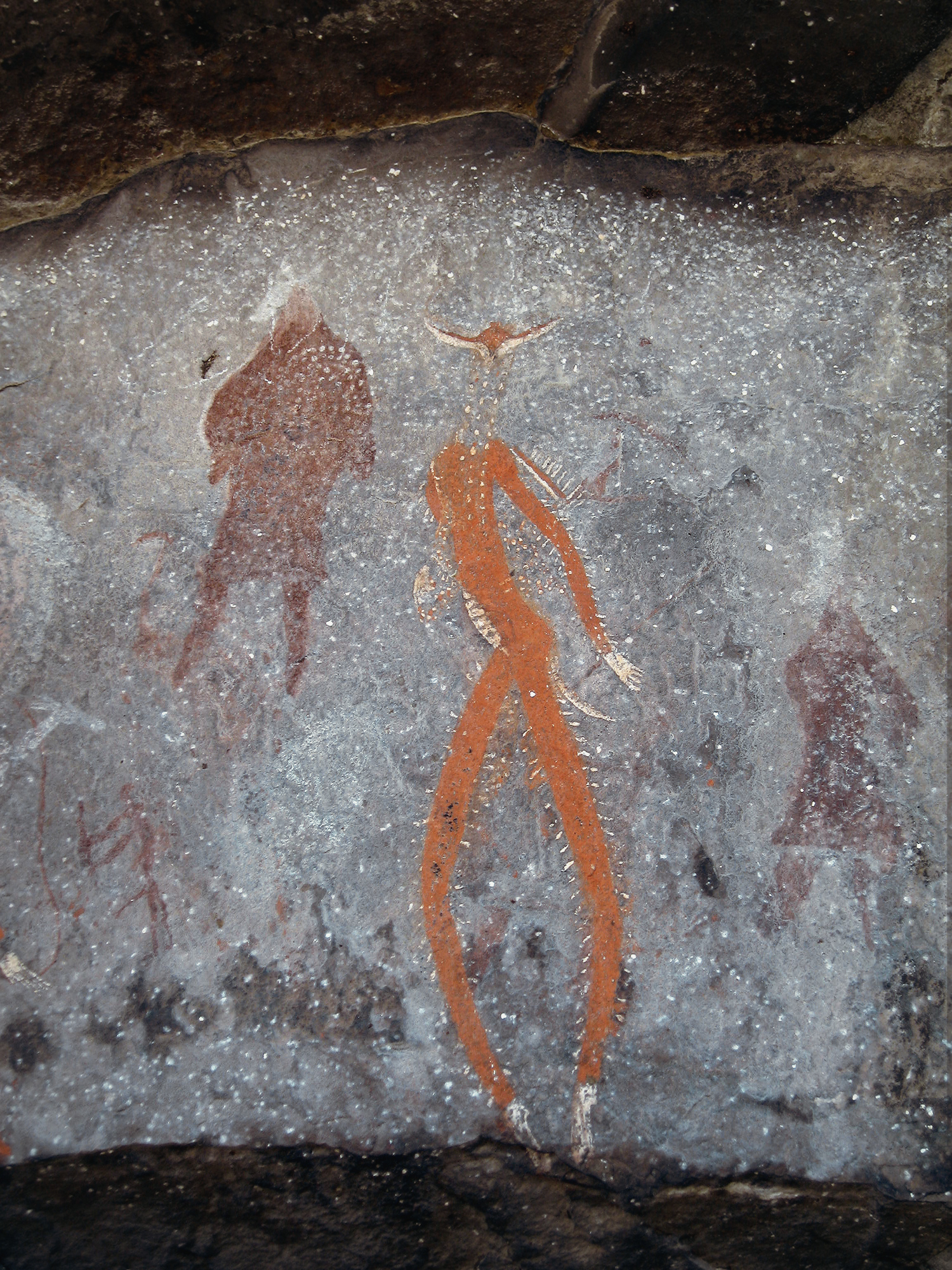
"The most important San ritual was the healing or trance dance. These dances continue to be practised amongst San groups living in the Kalahari today. Dancers stomp in a circle around the campfire for many hours. The women clap the rhythm of the dance and sing powerful songs. After hours of stomping, some dancers start to slip into trance. In this altered state of consciousness they may have out-of-body experiences. They describe travelling to the spirit realm.
The rock art paintings reflect the San travelling to the spirit realm
Those dancers who practise and utilise out-of-body experiences on a regular basis are termed shamans. Up to 40% of the members of any one group may be practising shamans.
The healing dance performed by San shamans to find and cast out sickness starts at night and carries on until dawn the next day. As well as living dancers, it was believed that the dancers were also attended by grotesque spirits of the dead.
The dance starts with a few women singing snatches of songs that are different from ordinary recreational songs. These special medicine songs contain n/om, a supernatural potency that permeates the cosmos but that resides particularly in large animals, such as giraffe and eland, and in the shamans themselves. Some San paintings are part human - part animal; these creatures are known as therianthropes, depicting dancers/shamans who have taken on the potency of a particular animal.
Soon the men start dancing around the women who have seated themselves in a tight circle around a central fire. The shamans push themselves towards an altered state of consciousness; they enter 'half-death'. They attain ecstasy simply by means of their dancing, concentration and hyperventilation, with the help of the women's insistent and rhythmic singing and clapping.
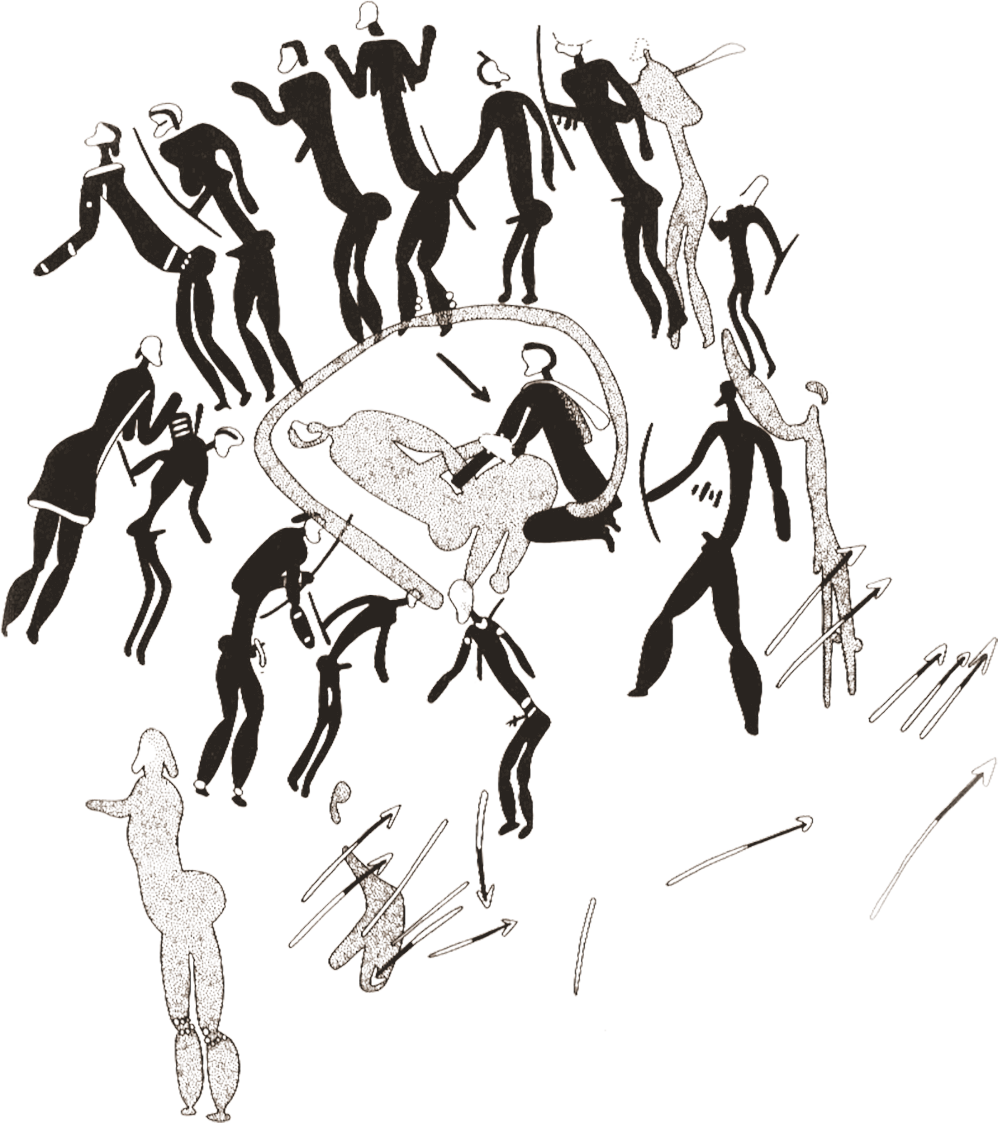
In half-death the shamans battle with malevolent spirits of the dead, who come to the dance and try to shoot small, invisible, 'arrows-of-sickness' into people. Attracted by the beautiful singing and dancing, the spirits lurk in the African night beyond the small circle of firelight. Balanced precariously on the edge of oblivion, experienced shamans move from person to person, laying hands on them and drawing known and unknown ills out of them. Then with a high-pitched cry they cast sickness and strife back into the darkness whence they came.
This image of a painting depicts a curing ritual, with a sick person lying with knees drawn up. Bending over the patient is a kneeling shaman who is laying hands on the patient to draw out sickness. Scattered around are depictions of arrows. These are probably not real arrows. The San never leave their extremely dangerous poisoned arrows where anyone may accidentally step on them or where children may find them. More probably, they are invisible arrows-of-sickness.
Sometimes, at the height of the dance, when the atmosphere is charged with n/om and the world is beginning to spin, some of the shamans fall unconscious in trance, sometimes casting themselves headlong into the fire. Their spirits have left their bodies on a dangerous, frightening and painful mission to protect their people. The most powerful shamans reach the terrifying abode of god himself, and there they remonstrate with him, pleading for the lives of any who may be critically ill.
People care for shamans who have entered trance, rubbing them with sweat and flicking them with flywhisks to deflect approaching arrows-of-sickness. Later, the unconsciousness of deep trance fades into natural sleep and the dance breaks up. In the morning, life goes on - cleansed - and the people, united by the great cathartic experience of the dance, return to the real life world of hunting and gathering.
Dying eland are common in San rock art. The explanation for this lies in the fact that the San word for dying is the same as the San word for entering deep trance. Many San painters depicted dying eland in close association with 'dying' dancers. The experiences of trembling, sweating and bleeding from the nose before finally collapsing were common to both; beyond this the eland was the supreme source of the potency sought by San dancers. The San describe their experiences of out-of-body travel as like flying."...
Article continues below
-end of excerpt- Notice that the dancers depicted in that second San Rock art drawing are moving counterclockwise.
In many of the YouTube videos of Southern African Zionist circle dances/spinning the people are also moving counterclockwise.
Umlindelo Wephasika -snip-
Gwanda is a town in Zimbabwe.
From Google translate Shona (and Zulu) to English: Umlindelo Wephasika =the Passover
**** Edited by Azizi Powell
Latest Update- January 17, 2022 12:21 AM EDT
This pancocojams post presents several online excerpts about Zionism (a referent for some of the African Independent Christian Churches in Southern Africa.
This post provides a brief (and therefore very incomplete) description of Zionism in Southern Africa.
This post also provides the only article quotes that I have come across to date about the fast pace walking and/or the circular spinning movement that is done by members of some Southern Africa Zionist churches (and by some of those churches' members who have emigrated to other nations throughout the world).
The content of this post is presented for historical, religious, and cultural purposes.
All copyrights remain with their owners.
Thanks to the founders, leaders, and all the members of Southern African Zionist churches. Thanks to all those who are quoted in this post and thanks to the publisher of this video on YouTube. -snip- The term "Zionism" has an entirely different meaning than the term "Zionism" that refers to Israel.
**** ONLINE EXCERPTS ABOUT ZIONISM IN SOUTHERN AFRICA
These excerpts are given in no particular order and are numbered for referencing purposes only.
EXCERPT #1 Fromhttps://en.wikipedia.org/wiki/African_Zionism "African Zionism, (also "amaZioni" from Zulu
"people of Zion") is a religious movement with 15–18 million members
throughout Southern Africa, making it the largest religious movement in the
region. It is a combination of Christianity and African traditional religion.
Zionism is the predominant religion of Eswatini and forty percent of Swazis
consider themselves Zionist. It is also common among Zulus in South Africa. The
amaZioni are found in South Africa, Eswatini, Mozambique, Malawi, Zimbabwe,
Botswana, and Namibia.[1]"
**** EXCERPT #2 From https://en.wikipedia.org/wiki/Zionist_churches "Zionist churches are a group of Christian denominations that
derive from the Christian Catholic Apostolic Church, which was founded by John
Alexander Dowie in Zion, Illinois, at the end of the 19th century. Missionaries
from the church came to South Africa in 1904 and among their first recruits
were Pieter Louis le Roux and Daniel Nkonyane of Wakkerstroom who continued to
evangelize after the Zionist missionaries left in 1908.[1]
History
The Zionist Churches proliferated throughout southern
Africa, and became African Independent Churches; research in 1996 suggested
that 40% of all black South Africans belonged to a Zionist church.[2]
The Old Cornerstone Apostolic Church in Zion of South
Africa, under Archbishop Mawethu Anthwell, had its beliefs grow out of late-nineteenth
and early-twentieth religious missions in Southern Africa. In particular the
churches owe their origins to the Christian Catholic Apostolic Church of John
Alexander Dowie, based in Zion, Illinois in the United States.
[...]
Characteristics of Zionist churches
Zionist churches are characterised by the following
features:
-Use of faith-healing and revelation through dreams
-"Jordan" baptism, in rivers
-Ritual garments, often mostly white, and prophetic staffs.
-Food taboos, such as not eating pork.
-Some smaller denominations worship in the open air, and
practise "wheel" dances—dancing in circles, sometimes to the beat of
drums.
-Some denominations accept polygamy.
-Some denominations show syncretic mixing of Christian and
traditional African religious beliefs"
****
EXCERPT #3 From https://www.britannica.com/topic/Zionist-church "Zionist church, any of several prophet-healing groups in
southern Africa; they correspond to the independent churches known as Aladura
(q.v.) in Nigeria, “spiritual” in Ghana, and “prophet-healing churches” in most
other parts of Africa.
The use of the term Zion derives from the Christian Catholic
Apostolic Church in Zion, founded in Chicago in 1896 and having missionaries in
South Africa by 1904. That church emphasized divine healing, baptism by
threefold immersion, and the imminent Second Coming of Christ. Its African
members encountered U.S. missionaries of the Apostolic Faith pentecostal church
in 1908 and learned that the Zion Church lacked the second Baptism of the
Spirit (recognition of extra powers or character); they therefore founded their
own pentecostal Zion Apostolic Church. The vast range of independent churches
that stem from the original Zion Apostolic Church use in their names the words
Zion (or Jerusalem), Apostolic, Pentecostal, Faith, or Holy Spirit to represent
their biblical charter, as for example the Christian Catholic Apostolic Holy
Spirit Church in Zion of South Africa. These are known in general as Zionists
or Spirit Churches.
The churches were introduced into Rhodesia (Zimbabwe) in the
1920s by migrant workers returning from South Africa; endless schisms and new
foundations followed. In the mid-1980s the largest was the African Apostolic
Church of Johane Maranke, which claimed about 260,000 adherents in Zimbabwe and
many others in surrounding countries.
[…]
Zionist churches include the following features: (1)
origination from a mandate received by a prophet in a dream, vision, or
death-resurrection experience; (2) a chieflike head, often called a bishop, who
is succeeded by his son and who is occasionally regarded as a messiah. Women
also figure as founders and leaders; (3) security received by the church’s
possession of its own holy place, such as a New Jerusalem, Zion, or Moriah City
as headquarters; ownership of land in the reserves and sometimes in white
areas; organization of farms and other economic activities; (4) healing,
through confession, repeated baptisms, purification rites and exorcisms,
especially at “Bethesda pools” and “Jordan rivers”; (5) revelation and power
from the Holy Spirit through prophetic utterances and pentecostal phenomena;
(6) ritualistic and Africanized worship, with special garments and innovative
festivals, characterized by singing, dancing, clapping, and drumming; (7) a
legalistic and Sabbatarian ethic, which includes taboos against certain foods,
beer, and tobacco and which does not admit Western medicines but tolerates
polygamy; and (8) repudiation of traditional magic, medicines, divination, and
ancestor cults; the Christian replacements for these traditional practices,
however, are sometimes similarly used and interpreted."
Department of Historical & Constructive Theology,
University of the Free State
[…]
"The socio-political events: Springboard of Zion Cities
African Zionism is mainly the result of socio-economic
changes that were shaping the South African socio-political landscape of the
19th century. After the population migration towards the emerging city centres
due to discoveries of diamonds and gold, the African traditional life
deteriorated. This escalated especially between the two world wars when African
life took a new shape in mine compounds, overcrowded locations, or slum yards
(Pretorius and Jafta 1997:217). Industrialisation and urbanisation swelled,
dislodging people from their roots and traditions, encouraging Africans to
embrace westernisation and Christianity by abandoning their socio-cultural
religious roots. This was met with resistance and rebellion in certain
quarters. Brown (2005:94) substantiates this:
Gradually this invasion by foreign whites and acculturation
pressures, i.e. forcing people to speak English and obey English laws and
customs, caused Zulu, Xhosa and other African people to experience
psychological stress while their culture was under constant attack. The African
response was that crime, alcohol abuse and lawlessness rose to frightening
levels due to anomie and normlessness.
The African National Congress (ANC) and the Industrial and
Commercial Workers Union engaged religion to address this African social
plight. This led to the emergence of Zion City churches, especially in urban
areas. These churches branded themselves with the name "Zion" as a
symbol of the New Jerusalem. Events in Wakkerstroom and urban centres were
dynamic, a new phenomenon was unfolding that influenced Christianity in South
Africa on a large scale. For instance, one of the leaders, Daniel Nkonyane
"introduced certain elements in worship: white robes, bare feet, holy
sticks, and Old Testament symbolism ..." (Pretorius and Jafta 1997:218).
These constitute the characteristic features of Zionism today.
In the meantime, the mission churches were flourishing in
emerging mining centres like Johannesburg and Kimberley, though with some
paternalistic tendencies that contributed to the attitude of supremacy of white
missionaries who disregarded the emerging African church leaders. These
missionaries were in control of the church governance and polity in all
structures and patterned themselves according to Western church polity
(Pretorius and Jafta 1997:213). The missionaries collaborated with the
government to confiscate land from the indigenous people.
Motlhabi (2008:38) points out that African Initiated
Churches' secession from the mainline churches was not just political and
economic. It was also theological and cultural, because:
They sought freedom both from 'an oppressive church
situation' and 'from deculturizing, de-Africanizing, detribalizing treatment,
and reacted...against a foreign, unadapted, western-oriented church which [did]
not take note of the African approach and worldview.'
The developments expressed above indicate that Western
Christianity was not reaching or fulfilling the deep spiritual needs of
Africans. Africans who seceded to form African Zionism needed something
spiritually significant. They needed something "emphasizing revivalism
that, through the 'African worldview' seeks to address Africans' authentic need
for deep spirituality and religiosity" (Akoto-Abutiate 2014:146).
This opens a wide field of research that leads to the
contribution of these churches in shaping the current South African
socio-cultural space. Much had been done, yet the researched knowledge is still
unpublished in the public domain as expressed by Kiernan (1974:80) decades ago:
The view that African Independent Churches are primarily a
reaction to White rule is thus a theme which is strongly entrenched in the
literature on the subject and represents a respectable body of opinion.
The fact remains that African Zionism or African Independent
Churches, and the African traditions or African worldview are irreversibly
symbiotic. Theron (1996:14) points out:
The whole of life in its aspects - politics, economy, family
relations, marriage, social relations, culture, customs - everything is
permeated with this religious world view of the African.
[…]
The contribution of African Zionism to African Christianity
The invaluable contribution of this branch of Christianity
is described by Pretorius and Jafta (1997:224-226; Anderson 1992:119-120).
These authors elaborate on the role of these African Zionists as a catalyst for
the emergence of the new society regarding their political and social impact
during the socio-political marginalisation of Africans in South Africa.
The first contribution of African Zionism to Christianity is
the preservation and perpetuation of indigeneity. At the heart of Zionism,
worship is practised according to cultural style. The songs are in the people's
languages, including choreography and general negritude. By negritude is meant
"the totality of the black experience - the culture, values, and
especially the spirit of black African civilisation" (Coetzee and Roux
2000:450). Africans experience connection with God in different ways than
Westerners. As Eastern people, for them worship is emotional - the whole being
is involved (body, soul and mind).
God calls for worship that involves our whole being. The body,
mind, spirit, and emotions should all be laid on the altar of worship. Often we
have forgotten that worship should include the body as well as the mind and
spirit. (Foster 1985:147)
Wepener and Barnard (2016:77) detail their experiences at
the ZCC worship, describing the mokhukhu (khaki clad men regarded as protectors
of the congregation) stamping their feet and jumping simultaneously, resulting
in deep sonorous sound accompanied by vibrating ground. The whole body and
being is involved in worship. In traditional churches influenced by the West,
worship, even through singing, disengages physical expression and rarely invoke
emotions. In fact, in Western Christianity emotionality is associated with
demonic expression during worship. Pretorius and Jafta (1997:223) remind us
that African Christians embrace a livelier and emotional worship with liturgy
accompanied by extempore prayers, uniforms, drums, dancing, and symbolic
instruments.
Switching on to any African radio station in South Africa, a
listener is confronted with Afro Christian music, popularly referred to as
Gospel music, such as the IPC choir. They sing traditional hymns with the same
lyrics, but with tempos and gusto that synchronise with African rhythms.
Realistically, contemporary Afro Gospel music derives its roots and influence
from African Zionism. Many mainline churches including the Roman Catholic
Church have embraced Afro Gospel music expressions in diverse ways. They have
incorporated hand clapping, cushion cymbals, drums (traditional and Western),
trumpets (vuvuzelas), ram horns, and bells in their worship in order to assert
their African-ness in worship. Foster (1985:147) notes that, "Standing,
clapping, dancing, lifting the hands, lifting the head are postures consistent
with the spirit of praise." Regardless of all these physical and emotional
expressions or instrumentations applied, the bottom line remains: "African
Christian music should be theologically sound and African in tune"
(Muthengi 1998:259). Thanks to African Zionism!"...
Reviewer: Edna Bonhomme "Joel Cabrita’s The People’s Zion: Southern Africa, the
United States, and a Transatlantic Faith-Healing Movement is a transnational
story about the role new forms of Christianity had in shaping concepts of identity
and community among religious believers, as well as the ways racial inequality
and segregation transformed in the nineteenth and twentieth centuries
[…]
Zion was founded in the late 1800s by the missionary John
Alexander Dowie, a transnational evangelical leader whose movement covered the
United States and southern Africa. In all of these contexts it found racially
and linguistically diverse communities who approached the faith in different
ways. Cabrita is attentive to the significance of these dynamics, and the
contrasting social contexts in which the sect was implanted. Christianity was a
web of ideology and social and cultural practices that was not exported
wholesale from place to place but was transported in the bodies and minds of
people. As Christian evangelism shifted from northern European and North
American contexts to the southern hemisphere, its new adherents remade the
faith in their own image in ways that made sense in their own environments.
This allows Cabrita to develop an illuminating comparison between the Zionist
movement among Americans in Chicago and black and white believers in southern
Africa.
[…]
In chapters 3 and 4 Cabrita explores the significance of
Zionist egalitarianism in sections that deal with cosmopolitanism and racial
exclusivism. The Zion church in South Africa was a contested terrain for
English- and Dutch-speaking settlers who were trying to envision themselves as
part of a transnational white community. Johannesburg was home to many
evangelical Protestant churches that became sites for the promotion of “racial
health” and imperial “white South Africanism” (p. 109). In the first part of
the twentieth century, the Zion congregation in Johannesburg eschewed racial
integration and maintained apartheid. Zionism began to integrate in South
Africa once rural black elites began to be drawn to the cosmopolitan project,
but such integration did not lead to material equality. While some white South
African Zionists were able to visit Chicago in the early twentieth century,
black South Africans did not.
After engaging in a thorough history of the social
experience of apartheid in South Africa, chapters 5 and 6 articulate the ways
that Zion churches emerged within a growing literate black population in other
southern African contexts, especially as they increasingly expressed
anti-establishment views. The explosion of churches among the urban middle
class and unskilled men happened mostly during the interwar period. At the same
time, popular healing practices were also linked to religion, and the Zion
movement was “a seamless continuation of indigenous healing therapies” (p.
192). While much is written about Zion’s connection to healing, Cabrita misses
an opportunity to further explore the dynamism of indigenous medical practices.
Chapter 6 also outlines how the reconfiguration of evangelical churches was
driven by inter-Southern African migration as a result of labor demands,
particularly in mining. The cosmopolitanism of the Zion church, for black South
Africans who came from a variety of ethnic and linguistic groups, elided those
differences. This was especially true for black migrants to South Africa.
However, perceptions about ethnic differences were not completely erased by
participation in the church, where ethnic patriots would sometimes make claims
to leadership of their compatriots within the church.
Chapter 7 returns to themes explored at the beginning of the
book, outlining the links between the North American and southern African Zion
churches. In both contexts, the Bible School and prophecies were central means
of galvanizing the congregations. This was mostly achieved by healing prayers.
The chapter goes on to explore how Protestants developed a transnational
movement that made claims to human equality. At the same time, transnational
connections in evangelical Protestantism emerged and were crystalized during a
broader imperial project in the latter half of the nineteenth century. Churches
functioned as a site for southern Africans to make sense of sickness, health,
and healing. Divine healing, too, was an international phenomenon that did not
develop in isolation. As Cabrita argues, the development of ideas of divine
healing in the Zionist church was part of a global shift in Christian healing
therapies. For southern Africans, medical and religious knowledge were
co-constituted, mutually reinforcing each other.
Divine healing practices existed in awkward tension with
other forms of Christian religiosity such as Victorian piety, which tended to
call for a passive response to sickness. Divine healing, in contrast, allowed
believers to find earnest and direct methods for remedy. These in turn could be
connected in the believer’s mind with religious faith, such that personal
holiness and disease management were closely interlinked.
Zionist advocacy of egalitarianism sometimes fell short of
what it might have been. Southern African Zionists did not explicitly challenge
apartheid. Leaders went so far as to say that apartheid officials were “God’s
servants for your [own] good” (p. 12). Their interventions in, or quiescence in
the face of, the political apparatus were paradoxical. "...
**** EXCERPT #6 From https://en.wikipedia.org/wiki/Samuel_Mutendi "Bishop Samuel Mutendi (c.1880-1976) was the founder of the
Zimbabwean breakaway branch of the Zion Christian Church, which under his
leadership grew to a membership of 250,000 at his death,[1] and which is
believed to be three times larger today[2] and one of the largest religious
organizations in the country. As the religious leader responsible for the
popularization of Zionist Christianity into Zimbabwe, he is arguably the most
influential religious personality in the country's history.
Early Years and Religious Calling
Mutendi was born in the Bikita region of Zimbabwe,
apparently to a family descended from the Rozvi royal line.[3] Before the late
1920s he went by his birth name of Samuel Moyo, but later changed it to Mutendi
as his stature as a leader was increasing. According to autobiographical
sections of his sacred writings, Rungano Rwa Zion Christian Church,[4] Mutendi
was born prematurely and was expected to die. The name "Mutendi" is a
shortened colloquial reference to his eyes opening after being left for dead by
his family members.[5]
Mutendi was literate even though he never attended school.
He was taught to read and write by a male relative. In his early adulthood he
took a job with the British South Africa Police and was stationed at
Chegutu.[6] According to the Rungano, Mutendi was visited by the Angel Gabriel
in 1913 at a time when he was not religious. Further visions, especially after
1919, encouraged him to seek a religious path and foretold his rise as a
religious leader. In the early 1920s Mutendi quit his police job and returned
to Bikita, where he joined the local Dutch Reformed Church mission. Mutendi
felt compelled to preach as a layman, but his accounts of his visions and his
calls for converts to experience "fire baptism" were unacceptable in
the conservative DRC.[7] During this time, three acquaintances of Mutendi's
ventured to South Africa as migrant workers, and were converted to Zionist
Christianity in the Transvaal. Mutendi then heard of his friends' experiences,
and went to South Africa himself with a colleague named Andreas Shoko.[8]
During their time in the Transvaal, Mutendi and Shoko were baptized by Engenas
Lekganyane.[9]
Around 1923, Mutendi returned to Bikita as a ZCC member and
began preaching. In early 1925 was part of a delegation that unsuccessfully
sought to register the church with the South African government.[10] Following
the secession, Mutendi led the Zimbabwean branch of the ZCC until his death fifty
years later.
[...]
The Growth of the Zion Christian Church in Zimbabwe
Mutendi's new church faced considerable difficulties in its
first decade or two. Due to the system of indirect rule, it was opposed by both
the White authorities and the chiefs who they ruled the reserves through.[12]
Mutendi was unable to register the church in his own country, and faced
considerable persecution during his evangelizing tours. According to the
Rungano, many of his adherents' churches and schools were burned down, while he
was arrested and imprisoned on numerous occasions.[13] In some areas his
followers were forced to conduct their services in secret in places such as
caves.
Over time Mutendi's reputation as a faith healer, rain
maker, and a man of immense spiritual power grew. He walked around with a large
entourage that proclaimed his deeds. During his itinerant tours, Mutendi
carried a "spriritual rod" named "Mapumhangozi" that was
supposedly blessed by Engenas Lekganyane.[14] This rod was used to heal the
sick and to effectuate other miracles. Due to these successes Mutendi was able
to win the support of a number of chiefs and thus to begin operating more in
the open without fear of arrest. Eventually, after years of suppression, the
government issued what Mutendi called a "Peace Order".[15] People
with illnesses or other issues began to venture from far and wide to seek his
counsel and intervention.[16]
After the nearly simultaneous death of Engenas Lekganyane and
the beginning of apartheid in South Africa, Mutendi's branch of the ZCC became
increasingly distinct from the main South African branch. Prior to 1948
Zimbabweans could travel freely to South Africa to visit the ZCC's two annual
pilgrimages. The apartheid government's new travel requirements rendered these
pilgrimages, as well as other contacts, far more difficult. Another bone of
contention was that Mutendi did not condone ancestor worship, as did the parent
South African church. In the early 1950s Mutendi built his own "Zion
City" near Bikita and erected his headquarters there. This site became the
new pilgrimage site for Zimbabwean ZCC members. As a result of the new reality,
Mutendi wrote his sacred text, the Rungano Rwa Zion Christian Church, which included
a new constitution that made it distinct from the Lekganyane ZCC.[17] Mutendi
also began to mandate the use of different sorts of sacred clothing by his
members. Over the decades, Mutendi's organization continued to grow and evolved
into Zimbabwe's largest church."... -snip- Here's some information about from his Wikipedia page https://en.wikipedia.org/wiki/Engenas_Lekganyane "Engenas
Barnabas Lekganyane (c. 1885–1948) was the founder of the Zion Christian Church
(ZCC). He first formed the ZCC in 1924, and by the time of his death the church
had at least 50,000 members. Under the leadership of his descendants the ZCC
has gone on to have more than a million members primarily located in southern
Africa.[1] It is now by far the biggest of the various Zionist Christian sects
that account for roughly half of all Christians in southern Africa.".... Click https://www.sahistory.org.za/article/zion-christian-church-zcc#:~:text=The%20ZCC%20took%20its%20name,based%20in%20Thabakgone%2C%20near%20Polokwane.&text=%5Biii%5D%20The%20ZCC%20grew%20rapidly,1935%20and%208000%20by%201940. for more information about the Zion Christian Church (ZCC).
**** EXCERPT #7 From Google Books: Who Needs a Missionary?: How the Gospel Works All by Itself https://books.google.com
› books
Robert Reese · 2014 · Religion …“Night services in rural Zimbabwe are always dimly lit by
candles or kerosene which often lend them an eerie glow. Most African worship is exuberant, but the
Zionist take it to another level. They
like to dance in circles and on that night they became like whirling dervishes.
Their singing and dancing in a circle, with each dancer spinning round and
round, robes swirling in the dim light, created a surreal scene. Faster and faster they spun as the singing
intensified. The scene was nothing short
of mesmerizing. Zionist always put an
incredible amount of energy into their worship, and frequently hold all night
prayer meetings in the bush.”….
**** EXCERPT #8 From https://fullerstudio.fuller.edu/interfaith-earth-care-and-dialogue-in-zimbabwe/ Interfaith Earth Care and Dialogue in Zimbabwe by Dana Roberts ..."My most memorable experiences of interfaith dialogue came in
the context of accompanying my husband, Inus Daneel, in his ministry among
Indigenous Churches and Traditionalists in Zimbabwe.
[…]
My own position as wife of “Bishop Moses” gave me a bird’s
eye view of practical interfaith activities.3 In addition to serving for
several years as vice president of the board of trustees of ZIRRCON*, I
accompanied Inus to outdoor church services in which he functioned as a Ndaza
Zionist bishop, dancing in a circle with the men and laying on hands to heal
people.”…
-snip- This sentence is written in italics to highlight it.
**** EXCERPT #9 From https://www.jstor.org/stable/1160267 Ritual Healing and Political Acquiescence: The Case of the
Zionist Churches in Southern Africa
Matthew Schoffeleers
Africa: Journal of the International African Institute
Vol. 61, No. 1 (1991), pp. 1-25 (25 pages)
Published By: Cambridge University Press
Ritual Healing and Political Acquiescence: The Case of the
Zionist ...
..."between some of the Zionist Churches and the South African
government, ... The rituals of healing place the needy in a circle of touching,
caring fellows."... -snip- Unfortunately, this is the only portion of this journal article that I have access to.
**** EXCERPT #10 From https://www.jstor.org/stable/24764001 Performing the Holy Spirit: Ritualised Manifestations of Faith in an African Independent Church
Published By: Association for the Study of Religion in Southern Africa (ASRSA) "This research examines the aesthetic manifestations of religious belief, particularly in the Holy Spirit, through consideration of the performative dimensions and ritualised behaviours in the church services of an African Independent Church, namely, the New Gospel Church in Zion of Africa (NGCZA). The significance of specific objects and activities within the sacred context and how these contribute to the performance of belief among the congregants is central to this consideration. Drawing on the ritual performance theories of Turner and Schechner, the article argues that NGCZA church activity is highly influenced by a belief in the Holy Spirit. The results also indicated that religious activity enables an environment that is conducive to the emergence of liminal identities. Enabled from within a ritual frame that guides proceedings, the use of religious objects such as uniforms, clothing and drums facilitate an invocation of the Holy Spirit for the purposes of healing. Religious belief, once enacted, results in highly performative activities and actions within spiritually charged spaces." -snip- Unfortunately, this is the only portion of this journal article that I have access to.
**** EXCERPT #11 From http://www.skeptron.uu.se/broady/sec/sec-20.pdf WHERE GOD LIVES
AN INTRODUCTION TO A STUDY OF THE INDEPENDENT CHURCHES IN
MAPUTO, MOZAMBIQUE
By
Ulla Alfredsson
In collaboration with
Calisto Linha, SEC Research Reports 20, 1998 [page 32] ... "Today in Europan Christian philosophy, not least in the Protestant
version, the human being is alone and at the mercy of God`s grace, in line with the
individualism that has developed over the centuries in Europe. In contrast, people brought
up in an African society traditionally have their roots, hope, strength and sense of
belonging within the collective. Consequently, within the Independent churches, the
individual´s despairs, sorrows, difficulties (and joy) are not left to that person alone; they
are felt and shared by all members of the congregation.
We have seen example of this, when after the mass, people, mostly women, have gone up,
knelt in the middle on the floor and told their stories. The stories were about how the
women had been robbed of their money or their belongings in one way or another.
The
churches and their members are poor and not able to give much material support, but what
they do give is moral support. In the church they all sing, dance and pray for the bereaved
person and in that way everone participiates in the loss.
The participation can go further than this. One woman told us, that in her church, when
someone had real serious problems, the whole congregation gathered in the church-building
for three days and nigths; fasting, praying, sleeping and all concentrating on the afflicted
one.
Sometimes the prophesy rituals demonstrate an illustrative mixture of collectiveness and
privacy. The congregation is singing and dancing around the person who wants to be
counselled, and in that way everyone is partaking in the ritual, but at the same time the
singing and dancing ensure that none can hear what is being said,either by the afflicted
person or the one making prophesies, and that any secrets revealed will remain secrets
between the two....
[...]
[page 34] But it is not only on Sundays people go to church. Every day there are
activities. Tuesday and Friday nights are devoted to healing and counselling,
performed in the same way as we have described above with people singing and dancing around
the person to be counselled in order to guarantee privacy."...
**** Thanks for visiting pancocojams. Visitor comments are welcome.