Translate

Showing posts with label South African religions. Show all posts

Monday, January 17, 2022

Karen H. Brown - "White Robes For Worship: The Umnazaretha of the Nazareth Baptist Church In South Africa" (journal reprint with a few notes)

Edited by Azizi Powell

This pancocojams post presents an almost complete reprint of a 1996 journal presentation by Karen H. Brown about the robes worn by the Nazareth Baptist Church In South Africa. This Africa Independent Christian demonination is also known as the “Shembe Church", from the last name of its founder.

The content of this post is presented for historical, religious, and cultural purposes. 

All copyrights remain with their owner.

Thanks to the founder and members of the Nazareth Baptist Church in South Africa. Thanks also to Karen H. Brown for research and writing on this subject.
-snip-
Click https://pancocojams.blogspot.com/2022/01/information-about-african-independent.html for a closely related pancocojams post entitled "
Information About African Independent Churches In Southern Africa & Information And Videos Of Nazareth Baptist Church Denomination Of South Africa."

****
SHOWCASE PAPER
[This is almost a  complete reprint of this presentation paper at the 1996 
Textile Society of America Symposium except for a small portion of the text and except for Karen H. Brown's notes and list of works cited. A few of the notes that are included in this article are given below this presentation.]

From https://digitalcommons.unl.edu/cgi/viewcontent.cgi?article=1879&context=tsaconf

Textile Society of America Symposium

Proceedings Textile Society of America

1996

White Robes For Worship: The Umnazaretha of the Nazareth Baptist Church In South Africa

Karen H. Brown
Indiana University

[page 229]
"South-eastern Africa was a major locus of Christian missionary activity during the 
19th and early 20th century and some dozen or more denominations took to the mission field among the Zulus. 1 A Zulu man, Isaiah Shembe (c. 1879-1935) was one of many attracted to the Christian faith. His independent and questioning nature, however, did not allow him to fit into the structure of the white-led missions. Shembe founded his own church, the Nazareth Baptist Church (lbandla lamaNazaretha), around 1910. Its beliefs and practices are based on a unique synthesis of Christian, largely Old Testament, dogma and Zulu traditional beliefs. In addition to its specific theology, the Church is well known for the charismatic family, the Shembes, who have led it for some 85 years and the characteristic uniforms for worship and dance worn by its followers. This paper is concerned with the white cotton textiles which have been shaped into gowns known as umnazaretha, after their followers, the amaNazaretha or Nazarites.2

From Isaiah Shembe's humble beginnings as an itinerant preacher and healer, the Church now has some 300,000 members who live throughout south-eastern Africa. 3 Church headquarters are in the black to\vTIship of Inanda, near the port city of Durban, however, many Nazarites worship at regional branches through out south-eastern Africa.  

They are served by a network of ministers and other Church officials who work with Isaiah Shembe's descendants to maintain traditions. The majority of the members are Zulu-speakers and the predominant language used in services is Zulu. Despite the Church's seeming emphasis on Zulu identity, as seen in their dance uniforms, people from other ethnic groups (such as Swazi and Shangaan, both culturally and historically linked to the Zulus) do attend services and often wear their own "traditional dress".

The Church is best known to outsiders for its annual dance festivals which attract thousands of members and visitors. Dance groups are determined by gender, age and marital status and their uniforms are either based on traditional Zulu dress or on Highlands military apparel. Church members consider dance to be a form of prayer, and participation in a dance regiment is an important aspect of the religious experience (Mthethwa 1989). The majority of members, however, are merely spectators at the major festivals. It is possible that the focus on these dance uniforms in both the popular and scholarly literature tells us more about the interests and concerns of outsiders rather than the attitudes of Church members towards the emblems of their faith. The pervasiveness of the white gowns worn for worship. services, funerals and other important gatherings indicate that these gowns are far more significant than the more spectacular dance apparel.

This paper will look at three aspects of these robes. First I will discuss their origins in the vestments of the white-led mission churches. Then I will tum to the ways in which a gown is acquired. Finally I will examine the spiritual significance of the robe 

[page 230]

and its place in the theology of the Church.


The origins of the umnazaretha

There is no evidence that Zulu-speakers in the pre-colonial era ever spun or wove cotton. Nor was woven cloth available to many before European traders arrived in the 1820s (Davison and Harries 1980). Popular dress in the early 19th century consisted of articles made from animal skins and plant fibers. 4 Thus the use of woven cloth and tailored clothing was part of the colonial and missionary penetration into the region (Etherington 1978). White communities required all African residents, Christian and traditionalist alike, to wear European clothing from the 1870s. An important step in converting to Christianity involved the casting-off of "heathen garments". African Christians who belonged to syncretic African churches like the Nazareth Baptist Church usually were initially converted through the mission churches and also retained their western apparel. 5

Because Isaiah Shembe led an independent group of African Christians he came under the close scrutiny of various branches of the South African government. Many of the earliest reports of these encounters include a mention, sometimes a detailed description, of both his clothing and that of his followers. These long, white robes as described by police constables and native affairs officials set them apart from those African Christians who adhered to the missions and who would not have often worn vestments off the mission station. 6 Nazarites were (and still are) usually compared to (and conflated with) the Zionists who also wear white gowns somewhat different in style (see Kiernan 1991 and Sundkler 1961,1976).

The earliest photographs I have seen of the umnazaretha were published in the 1930s (Dube 1936, Roberts 1936). They were taken during the last ten years of Isaiah Shembe's life and were clearly taken with his cooperation. In appearance, the gowns closely resemble those those worn today.7 Shembe claimed that the inspiration for his own clothing and that of his followers was received in a series ofvisions. 8 His biographer, in 1936, described him as wearing clothing which "resembled that of the ancient priests of the Jews" (Dube 1936, 92). Shembe's robes, in their design, closely resemble both the ecclesiastical garb worn by missionaries as well as those worn by biblical figures in the illustrations found in Zulu language bibles, prayer books and bible stories that were published during the first third of the 20th century.9 In turn, these prints were probably taken from a stock of Victorian-era bible illustrations popular in Europe and the United States at the end of the 19th century. The source of inspiration for these bible illustrations probably comes from two intertwined sources: liturgical dress and earlier religious painting.

Shembe, although illiterate until he was in his forties, was apparently able to repeat large sections of the Zulu-language bible from memory and had a vast knowledge of the Scriptures. 10 Most missionary societies throughout southern Africa by the tum of the century had published bibles and bible stories in the vernacular languages...  

[page 231]

[…]

Shembe's earliest known association with African Christians was in the Orange 
Free State around 1906 with the Methodist Church and later the African Native Baptist Church (Roberts 1936, 28-30) and it is likely that he was exposed to biblical literature in Zulu or Sotho at that time. 13 Many of his earliest followers in Natal had left the mission churches, including the American Board Church, and he is likely to have seen their publications. 14 Interesting comparisons can be made between the illustrations found in biblical literature published by missions close to Shembe's headquarters in Inanda and both the descriptions of Shembe's visions (recounted in Dube 1936 and Roberts 1936) and the photos taken in the 1930s, however, it is beyond the scope of this paper to examine this aspect of the dress of Shembe and his followers (see Brown 1995).

Contemporary reports noted that Shembe used a tailor in Durban to make up his designs and then sold them to his followers. 15 In the early photographs it is difficult to tell what types of material were used, but it appears to be heavy cotton sheeting. The umnazaretha worn today are made of light-weight white cotton sheeting and are fully cut with a yoke like that found on a choir robe. Although the male and female uniforms are similar, details clearly differentiate gender and social status. Men wear gowns which reach their knees while those worn by women are slightly longer and often have horizontal rows of stitching at knee-length. Married women cover their heads with a headscarf or an isicholo (the basket-like Zulu headdress). 16 They also wear a white shawl made of the same cotton material which is draped over their shoulders. A black fabric belt denoting their status as married women is tied around the waist. 17

Group leaders and other individuals with authority wear extra garments to indicate their status - such as a detachable, black fabric yoke, known as an isiphika, worn by female group leaders.18 Men who are preachers or evangelists wear a flowing gown which buttons down the front in either white, blue, green or turquoise modeled on those worn by Isaiah Shembe. Currently most wear dark green robes or cloaks.

Acquiring an umnazaretha

[page 232]

The majority of African Ipdependent Churches regard baptism as an essential event in the life of every believer and this is also true for the Nazarites (Sundkler 1961, 1976; Oosthuizen 1985). Although children raised in the Church wear the umnazaretha when attending services, a person is not considered a full member until she or he reaches 18 years of age and elects to undergo baptism. Baptisms are usually scheduled for a weekend dedicated to the celebration of Church festivals and a large group will be baptized together. The Church observes Saturday as the Sabbath, so baptisms take place on Sunday morning. Those who are to be baptised gather with the ministers in the morning and they proceed together to the local water source. Men and women gather in separate groups on the river bank. Each person removes his or her street clothes and dons an old white gown, usually a cast off umnazaretha, often in poor shape. The two groups then rejoin in order to pray and sing hymns. After this the men and women form two lines down to the water. Each individual is given the opportunity to privately confess their sins to an elder and pray with him. Then he or she queues in order to enter the water where they undergo full immersion. Those who resurface spluttering and upset are said to have had demons expelled. Upon returning to land each person changes into dry clothes and a new umnazaretha. Once the group has reassembled on the shore, they pray and return singing to the temple grounds. 1

Baptism, judging by the reactions of those who underwent it when I was in attendence, offers a fundamental spiritual experience for many followers. Many were clearly affected, some were weeping. All were in a solemn state preceding and following baptism. As they returned, singing hymns, the solemn mood slowly lifted and the singing became increasingly spirited. Interestingly, their return was not particularly acknowledged by the others who were busy preparing for the afternoon dancing. This experience thus is a personal one rather than one celebrated by the congregation of the faithful and is experienced internally rather than externally.

Although the design of the basic white gown has been clearly codified by years of Church tradition, I could find no evidence that there were strict controls placed over their manufacture today. This is different from the early reports where Isaiah Shembe is said to have had them made by a tailor and then sold them to his followers. Today, each new full member provides his or her own umnazaretha to be donned upon baptism rather than the elders providing such garb. These tend to cost nearly a full week's salary for a domestic worker or laborer, a large sum but considerably less than the dance uniforms.

Most individuals order theirs from Church members who work as seamstresses.20

"Garments of Heaven"

Isaiah Shembe's son and successor, Johannes Galilee (1904-1976), called the urnnazaretha "garments of Heaven" in a 1958 sermon. While speaking on the subject of faith, he told his congregation:

You say this is the dress of Heaven. Don't think you will reach Heaven just because you have worshipped many years .... A white dress cannot 

[page 233]


remove sin. We are evil and not worthy of being clothed in white. They 
are the garments of heaven. But Jesus lifts off the yoke. (Sundkler 1976, 185)

Here Johannes Galilee is reminding his followers that the white cotton gown alone will not absolve them from sin, and that each person must be vigilent against the many temptations of the world. This message was repeated quite vehemently in the 1990s to a Rockville, Soweto congregation I often visited. There Reverend Vilakazi and his fellow ministers called the umnazaretha a "reflection of heaven" when warming Nazarites of the very evident evils and temptations of the world around them. 21

The choice of the color white for the umnazaretha must be deliberate given its origins in ecclesiastical garb. Additionally, cotton sheeting is inexpensive and easily available. But most significantly, the color white has ritual and symbolic significance in both Christian and traditional African cultures. White, for most Christians, is usually associated with notions of purity and innocence. For many Africans, Christian and traditionalist alike, white is an element of a triad of red, black and white which helps mediate many rituals (Jacobson-Widding 1979, Renne 1991, Turner 1967, Ngubane 1977). This can be seen in the uniforms, robes and vestments worn by members of many different independent churches (Kiernan 1991, F ogelqvist 1986, Sundkler 1961, 213) as well as in the garb of members attending mainstream Christian churches in southern Africa (Moss 1989). Within the Nazareth Baptist Church, these colors dominate the dance uniforms worn by women and girls. Additionally, much of the beadwork consists of Latin cross patterns in primary colors, outlined by a row of black beads. This is placed on a ground of white beads, and the overall effect emphasizes a balance between the colors. For Zulu traditionalists, white is associated with goodness, light and the "good things of life, good health and good fortune" (Ngubane 1977, 113). For African Christians, this is extended to an identification with purity, the angels or Christ and Sundkler writes that "white is an active and effective colour: it carries with it purity and purification and acts as a guarantee that.. .. magic defilement has been washed away (1961, 213-4).

The umnazaretha, both a sign of baptism and membership in the Church, largely relate to notions of purity and strict rules determine the appropriate wearing of the gown. For example, they may not be worn following sexual intercourse when a Nazarite is considered ritually unclean. Acts of purification allow a return to normal behavior. This usually involves ritual bathing at a local water source, symbolically repeating the act of baptism. Members who break church laws have their gowns taken away for a period of time. This act, known excommunication, is done publicly and as is the reinstatement of the right to wear the umnazaretha (Roberts 1936, 79).

As the clergy of the Nazareth Baptist Church reminds us, a white umnazaretha is more than an outward sign of one's faith: it should reflect the thoughts and actions of its wearer. This inexpensive cotton sheeting, tailored into a simple, flowing gown, is transformed and given a sacred nature through the rite of baptism. It confers upon the  

[page 234]

Church faithful both the rights and obligations of membership, giving them a solid structure of belief and practice in an increasingly unpredictable, dangerous and chaotic society."
-snip-
Here are some of the notes that were given in that journal article:

16. The built-up headdress, isicholo, typically worn by married female traditionalists is rarely seen in the early photos 'of Church members when they are wearing the umnazaretha. Most of these women are wearing large and bulky head-ties, which might cover an isicholo. Photos taken in 1939 at a secular event, also show the married women in the umnazaretha and head-ties. In these photos it is clear that the overwhelming majority of women are not wearing the izicholo. See the Daily News April 4 and April 8, 1939.

17 . This belt known as iforteen or isibamba, is modeled on one originally worn by Isaiah Shembe but was transferred to the woman's uniform because so many of his early followers were female. The name iforteen refers to the day of the month when the women hold their meetings. Isibamba is a more generic term for a belt worn by Zulu women, although it is usually was made of fiber (or less commonly of beads) when worn by traditionalists. These belts cen be seen in the photographs from the 1930s. Even if Isaiah Shembe did once wear a black belt and added this to the women's uniform, it only replaced an item which was once associated with the state of marriage by traditionalists.

18 . According to Doke et aI., this is a cape for covering the shoulders (1990, 661 ).

These women are known as the umkhokheli, a term which can mean "one who pays another's debts" and also means the leader in a woman's church society (Doke et al. 1990, 398). These women are also responsible for collecting church dues from other women (personal communication, Inah Shoba, Nov. 21, 1992)"

****
Thanks for visiting pancocojams.

Visitor comments are welcome.


Saturday, January 15, 2022

Article Excerpt About The San People Of Southern Africa's Traditional Healing Dance (Is This A Source For The Southern Africa's Zionist Christian Denomination's Circular, Spinning Dances?)


Edited by Azizi Powell

This pancocojams post presents an excerpt of a Wikipedia article about the San people of Southern Africa.

This post also presents an excerpt of a bradshaw foundation article about San traditional healing dances as shown in their rock art.

The portion about the San healing dances is presented along with my question about  whether those dances are a source (or the main source) for the circular, spinning dances that are done by members of many Southern Africa's Zionist Christian churches. 

The content of this post is presented for historical, religious, and cultural purposes.

All copyrights remain with their owners.

Thanks to all those who are quoted in this post. Thanks also to the publisher of the video on YouTube that is embedded in this post. 
-snip-
This pancocojams post is part of an ongoing pancocojams series about religion in Africa.

****
DISCLAIMER
I'm an African American who knows very little about any Black cultures (or any other cultures) outside of the United States. However, I'm very interested in learning about other cultures, particularly about Black cultures throughout the world.

In 2016 I happened to come across YouTube videos of Southern African Zionist Christian church members walking and spinning in circles. Click http://pancocojams.blogspot.com/2016/02/south-african-isikhalanga-wafa-wafa.html for a 2016 pancocojams post that showcases YouTube videos of those dances (One of those videos is of a church in the United Kingdom which presumably was started by people of Southern African descent. Some of those videos use the words "Wafa wafa" in their title while some other titles for these videos include the word "isikhalanga". I think that word is used as a referent for those circular religious dances.

Here's a statement that I wrote in that 2016 pancocojams post:
The isikhalanga circular movement is somewhat similar to the 19th century (if not older) African American religious shouts. However, the videos of depictions of shouts that I've watched don't include the individual spinning that appears to be one of the key signatures of isikhalanga. That isikhalanga spinning movement reminds a little of the Sufi "whirling dervishes". That spinning also reminds me of the spinning movements of some traditional Igbo Nigerian masqueraders. This South African spinning movement also reminds me of the "wheel and turn" movements in Jamaican Kumina dancing."   

My interest in these religious dances was recently revived when I again happened upon some YouTube videos of Southern African Zionists and my online search for information about those dances led me to the article about San healing dances that is included in this 2022 pancocojams post. 

Here's an example of a YouTube video of the Southern African Zionist dancing that I'm referring to (I think this video is from Zimbabwe.) 

Spepa (Jimila kubekwa ilitshe likamkhululi.

Trevor Ncube Oct 3, 2018

-snip-
I sincerely apologize for my ignorance about these subjects and I mean no disrespect with my inquiries about the sources for these Zionist dances, their referents, and their religious and cultural meanings.

I would greatly appreciate any information and corrections about these subjects.  

****
ARTICLE EXCERPT ABOUT THE SAN PEOPLE
From https://en.wikipedia.org/wiki/San_people

The San peoples (also Saan), or Bushmen,[1] are members of various Khoe, Tuu, or Kxʼa-speaking indigenous hunter-gatherer cultures that are the first cultures of Southern Africa, and whose territories span Botswana, Namibia, Angola, Zambia, Zimbabwe, Lesotho[2] and South Africa. In 2017, Botswana was home to approximately 63,500 San people, which is roughly 2.8% of the country's population, making it the country with the highest population of San people.[3]

[…]

Names

The endonyms used by San themselves refer to their individual nations, including the ǃKung (ǃXuun) (subdivisions ǂKxʼaoǁʼae (Auen), Juǀʼhoan, etc.) the Tuu (subdivisions ǀXam, Nusan (Nǀu), ǂKhomani, etc.) and Tshu–Khwe groups such as the Khwe (Khoi, Kxoe), Haiǁom, Naro, Tsoa, Gǁana (Gana) and Gǀui (ǀGwi).[12][13][14][15][16] Representatives of San peoples in 2003 stated their preference of the use of such individual group names where possible over the use of the collective term San.[17]

Both designations "Bushmen" and "San" are exonyms in origin, but San had been widely adopted as an endonym by the late 1990s. "San" originates as a pejorative Khoekhoe appellation for foragers without cattle or other wealth, from a root saa "picking up from the ground" + plural -n in the Haiǁom dialect.[18][19] The term Bushmen, from 17th-century Dutch Bosjesmans, is still widely used by others and to self-identify, but in some instances the term has also been described as pejorative.[14][20][21][22]

Adoption of the Khoekhoe term San in Western anthropology dates to the 1970s, and this remains the standard term in English-language ethnographic literature, although some authors have later switched back to Bushmen.[4][23] The compound Khoisan, used to refer to the pastoralist Khoi and the foraging San collectively, was coined by Leonhard Schulze in the 1920s and popularised by Isaac Schapera in 1930, and anthropological use of San was detached from the compound Khoisan,[24] as it has been reported that the exonym San is perceived as a pejorative in parts of the central Kalahari.[20] By the late 1990s, the term San was in general use by the people themselves.[25] The adoption of the term was preceded by a number of meetings held in the 1990s where delegates debated on the adoption of a collective term.[26] These meetings included the Common Access to Development Conference organised by the Government of Botswana held in Gaborone in 1993,[15] the 1996 inaugural Annual General Meeting of the Working Group of Indigenous Minorities in Southern Africa (WIMSA) held in Namibia,[27] and a 1997 conference in Cape Town on "Khoisan Identities and Cultural Heritage" organised by the University of the Western Cape.[28] The term San is now standard in South African, and used officially in the blazon of the national coat-of-arms. The "South African San Council" representing San communities in South Africa was established as part of WIMSA in 2001.[29][30] "Bushmen" is now considered derogatory by many South Africans,[20][22][31] to the point where, in 2008, use of boesman (the modern Afrikaans equivalent of "Bushman") in the Die Burger newspaper was brought before the Equality Court, which however ruled that the mere use of the term cannot be taken as derogatory, after the San Council had testified that it had no objection to its use in a positive context.[32]

The term Basarwa (singular Mosarwa) is used for the San collectively in Botswana.[33][34][35] The term is a Bantu (Tswana) word meaning "those who do not rear cattle".[36] Use of the mo/ba- noun class indicates "people who are accepted", as opposed to the use of Masarwa, an older variant which is now considered offensive.[28][37]

In Angola they are sometimes referred to as mucancalas,[38] or bosquímanos (a Portuguese adaptation of the Dutch term for "Bushmen"). The terms Amasili and Batwa are sometimes used for them in Zimbabwe.[28] The San are also referred to as Batwa by Xhosa people and Baroa by Sotho people.[39] The Bantu term Batwa refers to any foraging tribesmen and as such overlaps with the terminology used for the "Pygmoid" Southern Twa of South-Central Africa."...

****
ARTICLE EXCERPT ABOUT SAN'S TRADITIONAL HEALING DANCES
From  https://www.bradshawfoundation.com/south_africa/san_rock_art/index.php The Eland in San Rock Art Paintings

In association with the Rock Art Research Institute, University of the Witwatersrand in Johannesburg, South Africa and The African Rock Art Digital Archive [no publishing date given; retrieved on January 15, 2022]

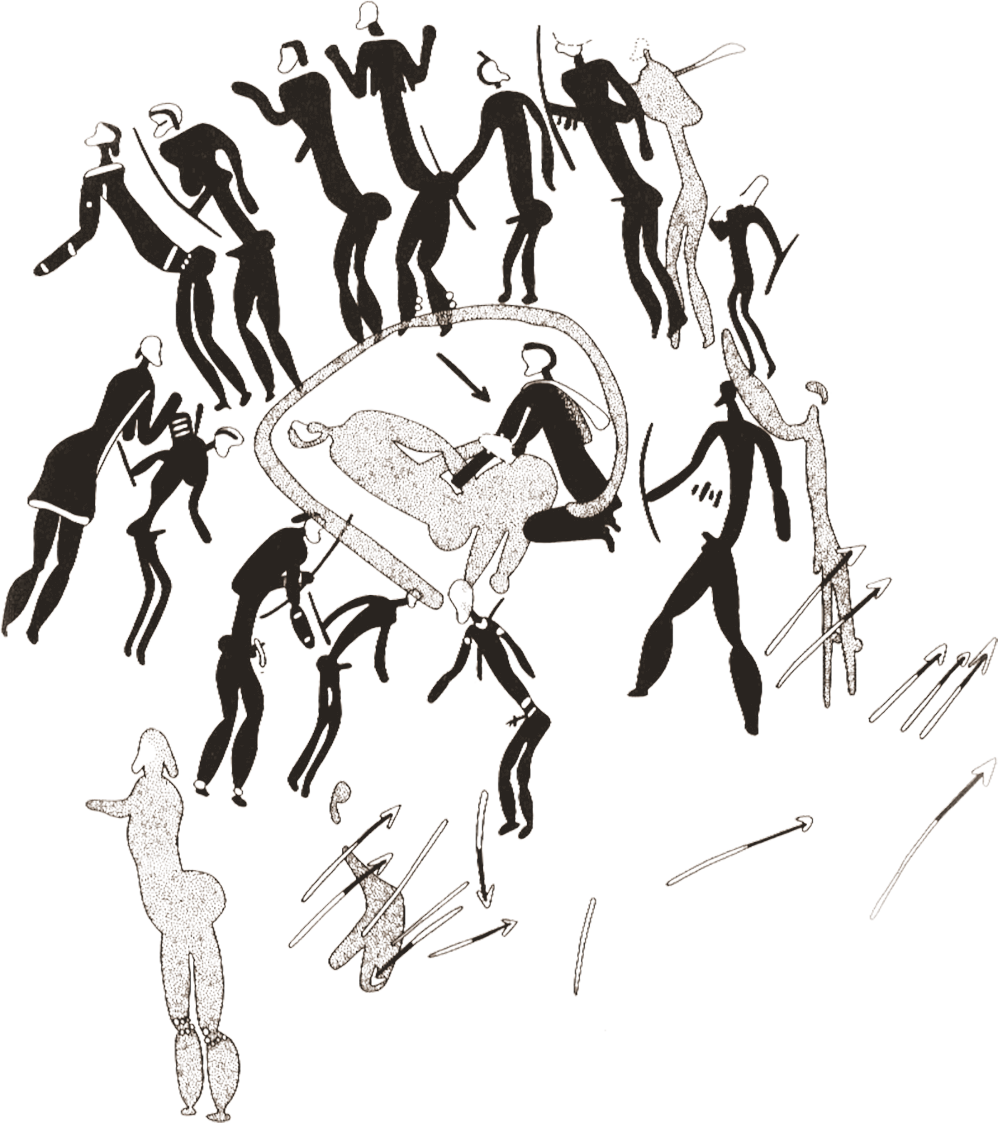
"The most important San ritual was the healing or trance dance. These dances continue to be practised amongst San groups living in the Kalahari today. Dancers stomp in a circle around the campfire for many hours. The women clap the rhythm of the dance and sing powerful songs. After hours of stomping, some dancers start to slip into trance. In this altered state of consciousness they may have out-of-body experiences. They describe travelling to the spirit realm.

The rock art paintings reflect the San travelling to the spirit realm San Rock Art South Africa
The rock art paintings reflect the San travelling to the spirit realm
 © Bradshaw Foundation
Those dancers who practise and utilise out-of-body experiences on a regular basis are termed shamans. Up to 40% of the members of any one group may be practising shamans.

The healing dance performed by San shamans to find and cast out sickness starts at night and carries on until dawn the next day. As well as living dancers, it was believed that the dancers were also attended by grotesque spirits of the dead.

The dance starts with a few women singing snatches of songs that are different from ordinary recreational songs. These special medicine songs contain n/om, a supernatural potency that permeates the cosmos but that resides particularly in large animals, such as giraffe and eland, and in the shamans themselves. Some San paintings are part human - part animal; these creatures are known as therianthropes, depicting dancers/shamans who have taken on the potency of a particular animal.

Soon the men start dancing around the women who have seated themselves in a tight circle around a central fire. The shamans push themselves towards an altered state of consciousness; they enter 'half-death'. They attain ecstasy simply by means of their dancing, concentration and hyperventilation, with the help of the women's insistent and rhythmic singing and clapping.

In half-death the shamans battle with malevolent spirits of the dead, who come to the dance and try to shoot small, invisible, 'arrows-of-sickness' into people. Attracted by the beautiful singing and dancing, the spirits lurk in the African night beyond the small circle of firelight. Balanced precariously on the edge of oblivion, experienced shamans move from person to person, laying hands on them and drawing known and unknown ills out of them. Then with a high-pitched cry they cast sickness and strife back into the darkness whence they came.

San Rock Art of the Drakensberg South Africa
This image of a painting depicts a curing ritual, with a sick person lying with knees drawn up. Bending over the patient is a kneeling shaman who is laying hands on the patient to draw out sickness. Scattered around are depictions of arrows. These are probably not real arrows. The San never leave their extremely dangerous poisoned arrows where anyone may accidentally step on them or where children may find them. More probably, they are invisible arrows-of-sickness.

Sometimes, at the height of the dance, when the atmosphere is charged with n/om and the world is beginning to spin, some of the shamans fall unconscious in trance, sometimes casting themselves headlong into the fire. Their spirits have left their bodies on a dangerous, frightening and painful mission to protect their people. The most powerful shamans reach the terrifying abode of god himself, and there they remonstrate with him, pleading for the lives of any who may be critically ill.

People care for shamans who have entered trance, rubbing them with sweat and flicking them with flywhisks to deflect approaching arrows-of-sickness. Later, the unconsciousness of deep trance fades into natural sleep and the dance breaks up. In the morning, life goes on - cleansed - and the people, united by the great cathartic experience of the dance, return to the real life world of hunting and gathering.

Dying eland are common in San rock art. The explanation for this lies in the fact that the San word for dying is the same as the San word for entering deep trance. Many San painters depicted dying eland in close association with 'dying' dancers. The experiences of trembling, sweating and bleeding from the nose before finally collapsing were common to both; beyond this the eland was the supreme source of the potency sought by San dancers. The San describe their experiences of out-of-body travel as like flying."...

Article continues below

-end of excerpt-
Notice that the dancers depicted in that second San Rock art drawing are moving counterclockwise.

In many of the YouTube videos of Southern African Zionist circle dances/spinning the people are also moving counterclockwise.

****
Thanks for visiting pancocojams.

Visitor comments are welcome.
Monday, May 11, 2020

Five Videos Of South Africa's URCSA Khayeitsha Congregation Singing & Playing iBeat Musical Instruments

Edited by Azizi Powell

This pancocojams post presents information about South Africa's URCSA (Uniting Reformed Church in Southern Africa denomination.

This post also presents information about Khayeitsha, South Africa.

This post also showcases five YouTube videos of URCSA Khayeitsha congregation singing. Most of those videos feature members of those congregations singing and playing a musical instrument whose Xhosa name is "umpampampas", but is colloquially called "ibeat". According to https://pdfs.semanticscholar.org/44f5/464c1570df0258d80affad087a77371f5782.pdf ..."umpampampas [are] (Bible-sized cushion covered with leather and beat with the palm of one hand), drums, sound pipes."...

Selected comment from the discussion threads for four of these videos are included along with the lyrics for one of these songs.

The content of this post is presented for religious, cultural, and aesthetic purposes.

All copyrights remain with their owners.

Thanks to all those featured in these videos and thanks to Sivuyisiwe Lutango, the publisher of these videos on YouTube.

****
Click https://pancocojams.blogspot.com/2019/10/videos-examples-of-south-africas-urcsa.html
for a October 5, 2019 pancocojams post that showcase videos of the South African Christian congregations which are known for their use of hand held cushions that are percussion instruments.

Click https://pancocojams.blogspot.com/2020/05/joyous-celebration-i-beat-south-african.html for a May 10, 2020 titled "Joyous Celebration - I Beat Medley" (South African Gospel Medley with special attention to the hand held cushion percussive instrument)".

****
INFORMATION ABOUT THE UNITING REFORMED CHURCH OF SOUTHERN AFRICA (URCSA)
From https://www.oikoumene.org/en/member-churches/uniting-reformed-church-in-southern-africa
"Uniting Reformed Church in Southern Africa
Church Family :
United and Uniting churches
Based in : South Africa
Present in : Lesotho, Namibia
Membership : 496,744
Pastors : 536
Congregations : 758

[...]

In 1994 the Uniting Reformed Church in Southern Africa (URCSA) was established through the union of the former Dutch Reformed Mission Church (DRMC) and the Dutch Reformed Church in Africa (DRCA). Both churches were the fruit of the mission work done by the Dutch Reformed Church in South Africa. Shortly after their arrival in 1652 the Dutch introduced slavery in the Cape and started a slave school to further the Christian religion, Dutch language and culture. The Dutch Reformed Church (DRC) of the time had no organized mission activity and accommodated all racial groups. The baptism of slaves was left to the will of their masters. Very few baptized slaves were however confirmed as members of the church. In due course various mission organizations from abroad started working in South Africa, which led to a number of denominations amongst the indigenous people and slaves. This motivated the DRC to start its own independent mission work in 1824. Although the 1829 synod formally rejected discrimination on the basis of skin colour, in practice people of colour were discriminated against, particularly at worship services and holy communion. The synod of 1857 decided to allow separate services for coloured members "because of the weakness of some". The next logical step was the formation in 1881 of the DRMC as a separate church for the converts of the DRC's mission work. In each province of South Africa separate churches for blacks and coloureds were formed. All the coloured congregations eventually joined the DRMC, and the black churches the DRCA. Both remained under the control of the DRC for decades.

In 1966 the DRMC decided in favour of structural unity between the churches of the DRC family. The DRCA put a similar emphasis on unification in 1975. It took another 19 years for that ideal to be partially fulfilled. The DRC did not join the union of the DRMC and the DRCA. The name of the URCSA (in the continuous tense) and its logo (an incomplete circle) reflect the church's emphasis on and hope for the re-unification of the DRC family and the wider family of God.”...

****
INFORMATION ABOUT KHAYEITSHA, SOUTH AFRICA
From https://www.tripsavvy.com/visiting-khayelitsha-township-cape-town-south-africa-4158886 "How to Visit Khayelitsha Township, Cape Town: The Complete Guide" Written by JESSICA MACDONALD
Updated 04/09/19
"Located in the Cape Flats area of the Western Cape, Khayelitsha is the second-largest black township in South Africa (after Soweto). It’s a 30-kilometer hop from Cape Town city center; and yet, life in Khayelitsha is very different to life at the prosperous heart of the Mother City, where elegant colonial buildings rub shoulders with world-class restaurants and art galleries.

The township, whose name means “new home” in Xhosa, is one of the poorest neighborhoods in the Cape Town area. And yet, despite its problems, Khayelitsha has earned itself a reputation as a hotbed of culture and entrepreneurship. Visitors to Cape Town are increasingly drawn there on guided township tours: here are some of the best options for a meaningful Khayelitsha experience.

Khayelitsha's History
Before planning a visit to Khayelitsha, it’s important to understand the township’s history. In 1983, the apartheid government announced its decision to re-home legal black residents living in informal settlements on the Cape Peninsula to a new, purpose-built site called Khayelitsha. Ostensibly, the new township was created to provide those living in sub-standard squatter camps with improved formal housing; but in reality, Khayelitsha’s role was to give the government better control over the area’s impoverished black communities by grouping them together in one place.

Legal residents were classified as those that had lived on the Cape Peninsula for more than 10 years. Those that didn’t meet that criteria were considered illegal, and many were forcibly repatriated to the Transkei, one of several black homelands created during the apartheid regime. When apartheid ended, people living in the homelands could once again move freely throughout South Africa. Many of those that had been removed from the Western Cape decided to return, along with countless migrants who flocked to Cape Town in search of work.

These migrants arrived with nothing, and many of them erected makeshift shacks on the edges of Khayelitsha. By 1995, the township had expanded to accommodate over half a million people.

Khayelitsha Today
Today, over two million people call Khayelitsha home, earning it its status as the fastest-growing township in South Africa. Poverty is still a crippling issue, with 70% of the township’s residents living in informal shacks, and a third having to walk 200 meters or more to access clean water. Crime and unemployment rates are high. However, Khayelitsha is also a neighborhood on the rise. New brick houses are being built, and residents now have access to schools, clinics and an incredible array of social development projects (including a canoe club and a cycle club)."...


****
SHOWCASE VIDEOS
Video #1: URCSA Khayelitsha Hosana 65(1)


Sivuyisiwe Lutango, Mar 14, 2018
-snip-
Selected comments from this video's discussion thread, with numbers added for referencing purposes only:
1. Hazel Nkosi, 2019
"So touched. AmaUniting amahle. U killing it. My church. I am a blessed CWL for 5 years"

**
2. Bessie Waller, 2018
"This is so beautiful, I wish could understand what the words they are singing in english"

**
3. Nxonxo Masixole, 2018
"Aawww nkosi yam iyandiphilisa umculo walenkonzo phambili maURCSA"
-snip-
Google translate from Xhosa to English
"Awww my lord brings me the music of this service in front of the URCSA"

**
4. Andiswa Nkabi, 2019
"Wooww am crying evry time ndimamele eliculo😢😢😢 ndicela nibhale iculo lonke please. Am blessed"

**
5. Sihle Tsengiwe, 2019
"Bhota mnqamlezo weNkos
Hlathi nqaba liwa lam
Xa uMtyholi eqhayisa
Zono xa zincamisa
Ngxonde yokusabela
Bhota mnqamlezo Nkos
2.
Khanya mnqamlezo weNkos
Gxotha ubumnyama bam
Khwezi lomso wothando
Langa lomhla woxolo
Ngqina lobulungisa
Khanya mnqamlezo weNkos
3.
Xhasa mnqamlezo weNkos
Xhasa seka qinisa
Ekulweni khaka lam
Phawu lwabasindiswa
Xhasa mnqamlezo weNkos
.4
Bhota mnqamlezo weNkos
Hlathi,nqaba,liwa lam
Xa kufika ukufa kwam
Yakuphela imihla yam
Nguwe olithemba lam
Bhota mnqamlezo weNkos
-snip-
Google translate from Xhosa to English:
"Bow the cross of the Lord
The forest is my stronghold
When the devil brags
When sins are overwhelming
A fortress of refuge
Cross the Cross Lord
2.
Shine the cross of the Lord
Cast out my darkness
The morning star of love
It's a day of peace
He is a witness of righteousness
Shine the cross of the Lord
3.
Support the cross of the Lord
Support and strengthen
In fighting my shield
The sign of the saved
Support the cross of the Lord
.4
Bow the cross of the Lord
A forest, a stronghold, my rock
When my death came
When my days are over,
You are my hope
Bow the cross of the Lord"

****
Video #2: URCSA Khayelitsha


Sivuyisiwe Lutango, Aug 22, 2018

Hosana 184: Vuthelani Ixilongo
-snip-
Google translate from Xhosa to English: "Blow the Trumpet"
-snip-
Selected comments from this video's discussion thread, with numbers added for referencing purposes only:
1. Athenkosi Mandlendoda, 2019
"Sizoyishaya ngempel'iKhayelitsha Aw Heshe Ntsizwaaa.... Looool, awu madoda yhiiini yhiiini yhiiiini.... iza!!! Watching these videos just revives me. Siyabulela!!!"
-snip-
Google translate from Xhosa to English:
"We are going to hit it off on a real day. Watching these videos just revives me. Thanks !!!"

**
2. Nelly Shange, 2020
"Ai,ai,ai, lesembatho singkhumbuza umama wami ai,ai,ai ukbe kukhona okwenziwayo ukvusa asebalala ngabe ngyakwenza"
-snip-
Google translate from Xhosa to English:
"Ai, ai, ai, this dress reminds me of my mother ai, ai, ai if something was done to wake her up she would have done it"

****
Video #3: URCSA Khayeitsha Hosana 106


Sivuyisiwe Lutango, Aug 22, 2018

Nkosi Ndive Ngezibele
-snip-
Google translate from Xhosa to English -"Lord Hear Me About Mercy"

****
Video #4: URCSA Khayelitsha Hosana 76


Sivuyisiwe Lutango, Aug 22, 2018

Kukho Umnqamlezo
-snip-
Google translate from Xhosa to English - "There is a Cross"

****
Video #5: URCSA Khayelitsha Hosana 353(2019 Easter Friday)


Sivuyisiwe Lutango, Apr 25, 2019
-snip-
Selected comments from this video's discussion thread, with numbers added for referencing purposes only:
Hellen Kekana, 2019
"I dont understand the words but joh! The synchronization and the boy with the bell moves me!!! Its electrifying 2🙌🙌"

**
malakia solomon lekgothoane, 2019
"The little boy with the bell yoooooh he blesses me"

****
Thanks for visiting pancocojams.

Visitor comments are welcome.