Translate

Showing posts with label Mardi Gras Indian songs. Show all posts

Sunday, May 16, 2021

Tu Way Pocky Way (Also Known As "Hey Pocky Way": A Timeline beginning in 1927 and including some YouTube links

Edited by Azizi Powell

Latetst Update - January 5, 2022

This pancocojams post provides a time line for the Mardi Gras Indian chant "Tu Way Pocky Way" (and various other spellings). This chant/song is also known as "Hey, Pocky-Way" (and similar titles). 

Some information about and YouTube links to most of these citations are also included in this pancocojams post.

The Addendum to this post presents the words to and my comments about a foot stomping cheer that I collected in 1985 from African American girls living in a community near Pittsburgh, Pennsylvania.  

The content of this post is presented for historical, cultural, and entertainment purposes.

All copyrights remain with their respective owners.

Thanks to all those who composed these chants and songs and all those who perform/ed these chants and songs. Thanks also to all those who are quoted in this post and all those who published these sound files or videos on YouTube.

****
A TIMELINE FOR "TU WAY POCKY WAY" (ALSO KNOWN AS "HEY POCKY A-WAY" 

1927- Louis Dumaine's Jazz instrumental "To-Wa-Bac-A- Wa"
Excerpt #1
From https://translate.google.com/translate?hl=en&sl=de&u=https://de.wikipedia.org/wiki/Louis_Dumaine&prev=search&pto=aue
"Louis Dumaine (born July 17, 1889 in New Orleans , † September 9, 1949 ibid. [1] ) was an American cornet player and band leader of New Orleans jazz . [2]

Louis Dumaine was a member of the Tuxedo Brass Band in the early to mid-1920s . He also played with the Henry Allen Brass Band , [3] the Eagle Brass Band , Kid Howard and trombonist Frankie Duson . In 1927 he recorded five tracks for Victor with his Dumaines' Jazzola Eight , such as “Pretty Audrey”, “Red Onion Drag”, “Franklin Street Blues” and “To -wa-bac-a-wa ". He accompanied the blues singer Ann Cook on “Mama Cookie” and “He's the Sweetest Black Man in Town”. Contributors included clarinetist Willie Joseph, trombonist Earl Humphrey, and pianist Morris Rouse. In the 1930s he continued to lead his own brass bands , such as the WPA Band in 1935 and the ERA Orchestra in 1936.

For the authors Rex Harris and Brian Rust , the Dumaines' Jazzola Eight played authentic New Orleans jazz that was created before the revival phase."
-snip-
Louis Dumaine's 1927 instrumental "To-Wa-Bac-A-Wa" was also mentioned in an article entitled "Mardi Gras Influence on New Orleans Music* . This article is copyrighted 2002 by Thomas L Morgan. That website's name was given as a hyperlink and is no longer available.

**
Excerpt #2
 
To Wa Bac A Wa

https://www.youtube.com/watch?v=ZRejOstWsTk

Louis Dumaine's Jazzola Eight – Topic, Nov. 8, 2014

Jazz The World Forgot Volume 1 ℗ Shanachie Released on: 2005-06-20

****
1938- Jelly Roll Morton on the Mardi Gras Indians (1938)

Alan Lomax Archive, Feb 6, 2015
-snip-
Jelly Roll Mortion describes the Mardi Gras Indians dancing in a ring while chanting "Tu way Pocka Way" (This is my phonetic spelling of this chant.)

****
1950 -book citation in Mister Jelly Roll: The Fortunes of Jelly Roll Morton, New Orleans Creole and "Inventor of Jazz" by Alan Lomax (originally published in 1950).
"The text from Allan Lomax's book MISTER JELLY ROLL reveals the Creole spelling as "T'ouwais, bas q'ouwais" and response "Ou tendais," though there have been other representations. One possible translation of the phrase is "I'll kill (tuez) you if you don't get out the way, " with the response "Entendez," or "I hear ya!"...
-snip-
This is a quote from an article that was entitled "Mardi Gras Influence on New Orleans Music. That website is no longer available. I quoted a portion of that article  in a Mudcat discussion forum comment that I wrote in  17 Jan 06 https://mudcat.org/thread.cfm?threadid=88125#1650526. The website's name was given as a hyperlink and the article was copyrighted in 2002 by Thomas L Morgan. 

****
1965- The Dixie Cups - Two Way Poc A Way
https://www.discogs.com/master/694246-The-Dixie-Cups-Two-Way-Poc-A-Way
-snip-
Thanks to Menno de Blaeij for alerting me to this record by email on Jan. 4, 2022.

****
1974- The Meters' song entitled "Hey, Pocky-A- Way"
Excerpt #1
From https://www.translateasy.com/en/song/the-meters-rejuvenation-album-hey-pocky-a-way-english-lyrics/6926  
"The loose and infectious melody of “Hey Pocky A-Way” has been covered and re-recorded many times since its first release in 1974 by New Orleans funk heavyweights The Meters. The highly recognizable chorus–which reputedly stems from early Native American dialects in the region that would come to cradle New Orleans–has lost most of its linguistic meaning, but none of its emotional acuity. Later, The Grateful Dead’s cover of the song popularized it further, even as members of The Meters went on to join the famous soul group, The Neville Brothers."
-snip-
This page also includes the complete lyrics to that song.

****
1987- The Greatful Dead- "Hey Pocky Way"
Excerpt #1:
From http://www.deaddisc.com/songs/Hey_Pocky_Way.htm
"The original recording of this song by The Meters and other recordings by the group use the title Hey Pocky A-Way. The majority of other recordings use the title Hey Pocky Way. The song was written in 1974. It incorporates traditional chants and a drum rhythm that was first used by Meters drummer Zig Modeliste on the Dr. John song Shoo Fly Marches On.

The Grateful Dead performed Hey Pocky Way about 30 times between September 1987 and July 1990.The song has also been performed by The Dead and Furthur."...
-snip-
Here's a list from that website for recordings of this song by various groups, including The Meters and the Greatful Dead. Note that a number of these citations have a  link for more information.

**
Excerpt #2

Grateful Dead - Hey Pocky Way 10/3/1987 [video]

https://www.youtube.com/watch?v=aAAHJS7DfRE

Brant Pittman, Aug 10, 2015

****

1991- The Neville Brothers - Hey Pocky Way

https://www.youtube.com/watch?v=_w-ibD-wBRo&ab_channel=NevilleBrothersonMVNevilleBrothersonMV [video]

Neville Brothers on MV

Recorded Live: 10/31/1991 - Municipal Auditorium New Orleans - New Orleans, LA


****
RECORD LISTS FOR THIS SONG 
From http://www.deaddisc.com/songs/Hey_Pocky_Way.htm

[Note: A number of these citations include a "info" tab which leads to more information about that record.]

Rejuvenation, The Meters, 1974

Single (Hey Pocky A-Way / Africa), The Meters, 1974

The Best of the Meters, The Meters, 1975

House of the Rising Sun, Idris Muhammad, 1976

Wild Tchoupitoulas, Wild Tchoupitoulas, 1976

Yellow Fever, Herbie Mann, 1979

Fiyo On The Bayou, Neville Brothers, 1981

Treacherous: A History of the Neville Brothers 1955-1985, The Neville Brothers, 1986?

Massive, Arrow, 1989

O'la Soca, Arrow, 1989

Keys to the Crescent City, Various Artists (Art Neville), 1991

Mardi Gras Party, Various Artists (Art Neville), 1991

Uptown Rulers: The Meters Live on the Queen Mary, The Meters, 1992

New Orleans Party Classics, Various Artists (Nevill Brothers), 1992

The Best of Louisiana Music, Various Artists (Meters), 1993

Funkify Your Life: The Meters Anthology, The Meters, 1995

Mardi Gras in New Oleans, Vol. 2, Various Artists (Meters), 1995

Roll Up The Rugs & Crank It: Live From Styleen's Rhythm Palace Syracuse, NY, Little Georgie & The Shuffling Hungarians, 1996

Bayou Bound, Poorboys, 1996

The Very Best of the Meters, The Meters, 1997

By Special Request, Van Broussard, 1997

Go-Go & Gumbo, Satchmo N Soul, Carte Brass & Percusion, 1997

Live in San Francisco, Leo Nocentelli, 1997

In Native, Soul Bossa Trio, 1997

A'capella New Orleans Volume 2, Jay-Ray & Gee with Friends, 1997

Uptown Rulin': The Best of the Neville Brothers, The Neville Brothers, 1999

Carnival '99, String Cheese Incident, 1999

Tribute, Van Broussard, 1999

Mardi Gras Party, Various Artists (Meters), 1999

Mardi Gras Essentials, Various Artists (Nevill Brothers), 2000

Bring A Friend, Flat Cat, 2000

The Blues Tribute To The Grateful Dead, Various Artists, 2001

Super Mann/Yellow Fever, Herbie Mann, 2001

Legacy 2: Toshiki Kadomatsu Presents Kudu Best Collection, Various Artists (Idris Muhammad), 2001

Simply Sound: Best Tracks 1993-2000, Soul Bossa Trio, 2001

Live in CPH, SP Just Frost, 2001

Drew's Famous Party Music: Mardi Gras, Hit Crew, 2001

We Got The Funky Blues, Roger Girke And The Funky Twisters, 2001

The Essentials, The Meters, 2002

Greatest Hits Vol. 2, The Lucky Devils, 2001

On the Road: July 4, 2002 Steamboat Springs, CO, String Cheese Incident, 2002

The Best of the Atlantic Years, Herbie Mann, 2002

Shakin' in the Makin', Ben Waters, 2002

Performances, Various Artists (Flat Cat), 2002

Live au Satellit'Cafe, Pierre Sibille, 2002

Pure Swamp Pop Gold, Vol. 4, Various Artists (Van Broussard), 2003

20th Century Masters: The Millennium Collection: The Best of the Neville Brothers, The Neville Brothers, 2004

Doctors, Professors, Kings and Queens: The Big Ol' Box of New Orleans, Various Artists (Meters), 2004

On The Road: July 10, 2004, Morrison, CO, String Cheese Incident, 2004

On The Road: October 5, 2003, Philadelphia, PA, String Cheese Incident, 2004

On The Road: October 29, 2004, Chicago, IL, String Cheese Incident, 2004

DSO Live: Jan 29, 2004, Charlotte, NC, Dark Star Orchestra, 2004

DSO Live: Jan 31, 2004, Raleigh, NC, Dark Star Orchestra, 2004

DSO Live: Feb 6, 2004, Pompano Beach, FL, Dark Star Orchestra, 2004

DSO Live: Mar 15, 2004, Winooski, VT, Dark Star Orchestra, 2004

CTI Master Collection, Vol. 2, Various Artists (Idris Muhammad), 2004

Gold, The Neville Brothers, 2005

On The Road: October 29, 2005, Las Vegas, NV (Orleans Ballroom), String Cheese Incident, 2005

On The Road: Archive Series: New Orleans, LA, May 1, 1999, String Cheese Incident, 2005

The Sandwich Man: With a Large Side of Love, Featuring Hammond Sandwich and Dark Star Orchestra, 2005

New Orleans Party Classics, Various Artists (Neville Brothers), 2005

PhryPhest, Great American Music Hall, SF, CA, July 5, 2006, Steve Kimock / ALO / New Monsoon, 2006

On The Road: June 25, 2006, Los Angeles, CA, String Cheese Incident, 2006

From the Big Apple to the Big Easy: Madison Square Garden Concert, Various Artists (Nevill Brothers), 2006

Live @ JZ, Monique diMattina/ Andrew Swann, 2006

Hard Ticket, Michael Schatte, 2006

New Orleans Mardi Gras, Dukes of Dixieland/Luther Kent, 2006

Taillights, Johnny Duke and the Aces, 2006

On The Road: July 29, 2007, North Plains, OR, String Cheese Incident, 2007

12/29/07, Beacon Theatre, New York, NY, Gov't Mule, 2007

Revolutions In Sound: Warner Bros. Records: The First Fifty Years (10 CD), Various Artists (Meters), 2008

Revolutions In Sound: Warner Bros. Records: The First Fifty Years (USB), Various Artists (Meters), 2008

Trick or Treat Box Set, String Cheese Incident, 2009

YarmonyGrass, August 16, 2008, Rebel Alliance Jam, 2009

Authorized Bootleg: Warfield Theatre, San Francisco, CA, Feb 27, 1989, Neville Brothers, 2010

On The Road: July 30, 2010, North Plains, OR, String Cheese Incident, 2010

Iridium Live 004: 7.12.2012, Donna Jean Godchaux Band, 2012

On The Road: July 20, 2012, North Plains, OR, String Cheese Incident, 2012

From The Archives 2/12/17, Voodoo Dead, 2020

****

ADDITIONAL YOUTUBE LINKS FOR  THIS SONG 

Hey Pocky A-Way (A Way) [sound file]

https://www.youtube.com/watch?v=KsVn6gt8HN4&ab_channel=TheWildTchoupitoulas-TopicTheWildTchoupitoulas-Topic

The Wild Tchoupitoulas - Topic, July 29, 2018

℗ 1976 Island Records, a division of UMG Recordings, Inc.

Released on: 1976-01-01

Producer: Allen Toussaint

Producer: Marshall E. Sehorn

Composer  Lyricist: Arthur Neville

Composer  Lyricist: Charles Neville

Composer  Lyricist: George Porter Jr.

Composer  Lyricist: Joseph Modeliste

Composer  Lyricist: Leo Nocentelli

****
Tu Way Pocky Way [sound file]

https://www.youtube.com/watch?v=G1caXKSHSVw

Big Chief Juan Pardo & Golden Comanche's - Topic, Oct 10, 2015

Tu Way Pocky Way · Big Chief Juan Pardo · Golden Comanche's

Spirit Food

℗ 2015 Big Chief Juan Pardo

****
ADDENDUM- TWO WAY PASS AWAY"  (foot stomping cheer)

1985- "Two Way Pass Away" foot stomping cheer

TWO WAY PASS AWAY
All: Two way pass away. Two way pass away.
Soloist #1: Well, my name is Shana.
Group: Two way pass away.
Soloist #1: And if you don’t like it,
Group: Two way pass away.
Soloist #1: You can kiss what I twist.
And I don’t mean my wrist.
-African American girls (around 8-12 years old), Braddock, Pennsylvania, collected by Azizi Powell, 1985

(Repeat the entire cheer from the beginning with the next soloist and continue repeating until every member of the group has had one turn as the soloist.)

While we waiting for more children to come to the African storytelling session that I was scheduled to perform, I asked the girls who were present what rhymes and cheers they knew. I wrote the cheers down as the girls performed them and asked them to repeat them when I wasn't sure about the words. I recall these girls performing more than two cheers. However, the only other cheer that I now have in my files is a version of "Cheerleader".

The girls stood in a horizontal line to perform this and some other cheers. I remember that a few girls "sat out" some of the cheers. I believe that was because they didn't know that particular cheer that well and therefore weren't sure about their ability to "keep to the beat" or remember the words. (Remembering the words to "Two Way Pass Away" was easy because the only change in words for each soloist was that soloist's name or nickname.)

I didn't write down how the girls performed any of these cheers. In the pancocojams post entitled "Overview of Foot Stomping Cheers" *, I wrote that m
ost foot stomping cheers use this beat pattern: "stomp clap/ stomp stomp/ clap". Another beat pattern is "stomp stomp clap/ stomp stomp clap." If I recall correctly, the beat pattern for "Two Way Pass Away" is "stomp clap/ stomp stomp/ clap". However, if I recall correctly, the soloist and the other chanters (steppers) paused the beat pattern for the words "You can kiss what I twist/and I don't mean my lips". On those words, the soloist switched one hip and said those words with a "sassy attitude". Those words were immediately followed by the entire group beginning the chant again with a new soloist (until everyone in the group had one turn as the soloist.) 

I didn't note down the names of the girls who performed "Two Way Pass Away" as I did for the only other cheer that was performed during that session which I still have notes for. However, since most of the girls performed all of the cheers that they shared during that session, it's likely that the same girls whose names I documented for that version of "Cheerleader*" were the ones who performed "Two Way Pass Away". Those girls were Shayla, Shana, Shana, Jamie, and Jackie. Note that this "Two Way Pass Away" cheer includes the name "Shana", one of the names for the girls who performed "Cheerleader". (I didn't give fake names to the chanters in these examples). The only difference is that I wrote that those girls who performed that version of "Cheerleader" were 10-12 and I wrote that the girls who performed "Two Way Pass Away" were 8-12 years old.   

I've come across multiple versions of the "Cheerleader" foot stomping cheer, although none of the other examples of that cheer are the same as that Braddock, Pennsylvania version. In contrast, that 1985 session remains the only place that I've come across the "Two Way Pass Away" cheer.  I never saw those girls or the woman who hosted that session again. I regretted failing to ask the girls some questions about that "Two Way Pass Away" cheer (for instance, did any of their families have any connection to New Orleans, Louisiana and any connections to the Mardi Gras Indians). In 1990, when the Talbot Towers public housing development was torn down Iremember regretting that I'd further lost the opportunity and find out more information about that "Two Way Pass Away" cheer.   

I believe that the phrase "two way pass away" is derived from the Mardi Gras Indian chant "Tu Way Pock A Way". When I heard this cheer performed in 1985, I didn't know anything about the Mardi Gras Indians, and I've never heard the chant "Tu way pocka way" or the song "Hey, Pocky-a Way". I remember writing the cheer down as "Too way pass away" and I remember asking the girls what those words meant. They said that they didn't know what it meant. It was only after I learned about the Mardi Gras Indians (in the mid 1990s) that I began using "Two" as the spelling for that word instead of  "Too". 
-snip-
*Click http://pancocojams.blogspot.com/2013/05/an-overview-of-foot-stomping-cheers.html#:~:text=Foot%20stomping%20cheers%20are%20composed,has%20a%20short%20solo%20portion for the pancocojams post entitled "An Overview Of Foot Stomping Cheers (Part I- Characteristic & Sources)"

**Click http://pancocojams.blogspot.com/2016/09/foot-stomping-cheers-alphabetical-list.html for Version #4 of "Cheerleader: Braddock, Pennsylvania 1985). 
 

****
Thanks for visiting poancocojams.

Visitor comments are welcome.

Sunday, February 21, 2021

2014 Mardi Gras Indian Trailer for the Documentary "We Won't Bow Down" (with information about the Jan. 2020 full documentary)


We won't bow down, Jan 30, 2014

Enter the secret culture of African-American artists, tribesmen, and warriors as they maintain the spirit and traditions of their ancient ancestors in modern-day New Orleans.

Music in this video:

Song: Shallow Water (Oh Mamma)

Artist: Shotgun Slim

****
Edited by Azizi Powell

This pancocojams post showcases a brief trailer of a documentary on Mardi Gras Indian culture. That trailer has one mildly violent scene of two Mardi Gras Indians confronting each other and one example of a mild curse word (the word "ass:).

A 1:02 trailer of "We Won't Bow Down Trailer ,60 clean" is available at https://www.youtube.com/watch?v=4LLEKHn4dlM&ab_channel=WeWontBowDown That trailer has no violence and no curse words. The long awaited full documentary for "We Won't Bow Down" was posted on YouTube on YouTube on Jan 28, 2020.  

WARNING: The full documentary contains lots of explicit language (profanity) throughout the documentary. However, the documentary is very informative and is high quality in its production and is very rich in its historical and cultural content. The link for the full documentary is  https://www.youtube.com/watch?v=wZSNWvGj9Wg&t=163s&ab_channel=WeWontBowDown .

This pancocojams post quotes the summary of that full documentary., with particular attention to the songs that are sung in that documentary. I've also included the titles of some of the other Mardi Gras songs I heard i that documentary.

The content of this post is presented for cultural, entertainment, and aesthetic purposes.

All copyrights remain with their owners.

Thanks to the Mardi Gras Indian culture for this song. Thanks to all those who are associated with this documentary. Thanks also to all those who are showcased in this trailer and this documentary. 

****
"WE WON'T BOWN DOWN" DOCUMENTARY FILM

"WeWontBowDown

Director: Chris Bower

Producer: Monica R. Cooper // Steve Mann // David Kabler

Cinematographer: Daniel Judson

Editors: Chris Bower // Daniel Judson

Music in this video

Song - Sew-Sew-Sew (Live)

Artist: The Golden Eagles

[...]

Song: Handa Wanda

Artist: Bo Dollis

Album: 30 Years & Still Wild

Song: Shallow Water (Oh Mamma)

Artist:  Shotgun Slim

Album: Tuba Fattz Lil' Cuzzin"
-snip-
Here are some other songs that I heard in that documentary
“Indian Red”

“My Big Chief Has A Golden Crown”

“Make A New Suit”

“Hey Now, Here They Come

“Little Liza Jane” (a Mardi Gras Indian version)

****
Thanks for visiting pancocojams.

Visitor comments are welcome.
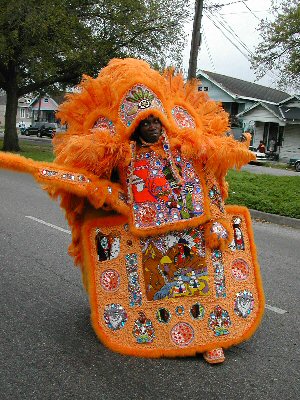

Danny Baker - "Tootie Ma Is A Big Fine Thing" (information & Preservation Jazz Band lyrics )


Danny Barker, Jan 9, 2016
-snip-
Click https://www.youtube.com/watch?v=cfGyIOUGkrM&ab_channel=PasteMagazine for a YouTube video of  Preservation Hall Jazz Band's version of  "Tootie Ma Is A Big Fine Thing".

****
Edited by Azizi Powell

Latest revisions including title change- June 14, 2021 

This pancocojams post presents an excerpt of a 2002 article by Thomas L. Morgan entitled "Mardi Gras Indians Influence on the music of New Orleans".

This post also showcases a YouTube sound file of the Preservation Hall Jazz Band with Tom Waits rendition of the the traditional Mardi Gras Indian song "Tootie Ma Is A Big Fine Thing".  

Lyrics for a traditonal version of this song are included in this post along with lyrics for the Preservation Hall Jazz Band version that were posted in that YouTube sound file's discussion thread.

The content of this post is presented for cultural, entertainment, and aesthetic purposes.

All copyrights remain with their owners.

Thanks to Danny Baker for his musical legacy. Thanks also to the Preservation Jazz Band and others who have recorded the song "Tootie Ma Is A Big Fine Thing". Thanks to all those who are quoted in this post and thanks to the publisher of this featured example on YouTube.
-snip-
Click https://pancocojams.blogspot.com/2021/02/three-youtube-examples-of-mardi-gras.html for the pancocojams posts entitled "Three YouTube Examples Of The Mardi Gras Indian Song "Iko Iko" (also known as "Jockomo").

Also, click 
http://pancocojams.blogspot.com/2014/03/meet-de-boys-on-de-battlefront-mardi.html for a pancocojams post entitled "Wild Tchoupitoulas - Meet De Boys On De Battlefront (Mardi Gras Indian song examples, information, & lyrics)". That post includes some information about the Mardi Gras Indians.

****
ARTICLE EXCERPT: "Mardi Gras Indians Influence on the music of New Orleans"
Copyrighted 2002 - 2014 by Thomas L Morgan

https://tlmorgan.com/next/indian.html

...."Mardi Gras Indians have been a part of New Orleans' music and culture for more than 100 years according to some sources and much longer according to others. In many ways what makes Mardi Gras Indians unique is out of sight from most people. Even today there are limited interactions between the Indians and mainstream New Orleans culture. There may be weekly practices at neighborhood watering holes in the fall and winter leading up to Mardi Gras. Even on Mardi Gras Day the unveiling of the year's suit and other activities are limited to the local neighborhoods. Then there are mass appearances on the night of Saint Joseph's Day and Super Sundays and maybe even Jazz and Heritage Festival appearances where the Indians are probably seen by more people but at the same time are completely out of their element.


There are some specific examples in the 20th Century where the titles of the Indian songs inspired New Orleans music and later on more clear examples where their music and lyrics were obvious inspirations. The Creole patois found in the lyrics is rooted in oral tradition and is accompanied by percussion instruments. Most songs are chanted and make liberal use of the call and response tradition. The main song sung normally at the beginning and at the ending of Indian gatherings is "Indian Red," also known as the "Indian prayer." Other titles include "Shallow Water," "Handa Wanda," "Two-Way-Pocky-Way," as well as song reworked from their traditional roots such as "Shoo Fly" and "Little Liza Jane." New songs are added occasionally and older ones reworked to meet the situation.


The first known song to make use of an Indian phrase was Louis Dumaine's 1927 instrumental To-Wa-Bac-A-Way".  Sadly this version's only resemblance to Indian music is in the title. The song that became known as Two Way Pock Y Way started out with specific dance steps accompaning the beat and lyrics according to former Big Chief of the Yellow Pocahontas, Allison "Tootie" Montana.


Jelly Roll Morton's 1938 Library of Congress recordings gives some insight into what Mardi Gras Indian culture was like at the turn of the Twentieth Century. These recordings were never widely distributed nor even known by the general public, so they certainly did not contribute to spreading any influences of New Orleans Indian music. As to the recordings themselves, Morton reveals that he was once may have been a spyboy, though doesn't mention to which tribe he belonged. He does talk about the Spyboy's purpose in the tribe. He reveals that at that time in the city there were four or five tribes. He also gives examples of a couple of Indian chants and accompanying dances. The text from Allan Lomax's book MISTER JELLY ROLL reveals the Creole spelling as "T'ouwais, bas q'ouwais" and response "Ou tendais," though there have been other representations. One possible translation of the phrase is "I'll kill (tuez) you if you don't get out the way, " with the response "Entendez," or "I hear ya!"....

****

INFORMATION ABOUT "TOOTIE MA IS A BIG FINE THING" AND THREE OTHER SONGS RECORDED BY DANNY BAKER IN 1946 
From https://www.myneworleans.com/moulding-the-music/ Moulding the Music: Danny Barker in the here and now; 02/01/2016 Jason Berry
"In 1946, the balladeer Danny Barker played guitar and sang four tracks for a short-lived New York label that constitute the first songs of Mardi Gras Indians – a term of no media currency back then. “Indian Red,” has had many reincarnations since.

Barker also sang a paean to a Big Chief’s woman killed in a crossfire, “Corinne Died on the Battlefield,” which Willie T. and Bo Dollis refitted as “Corey Died on the Battlefield” for The Wild Magnolias in 1973.

Another tune, “Chocko Me Feendo Hey,” was popularized in 1954 as “Jockomo” by Sugar Boy and the Cane Cutters, and 10 years later as a refrain in “Iko Iko” by the Dixie Cups. Barker didn’t create the lines but was the first to use them in studio with a long reach back to streets of his youth.

The last song, “Tootie Ma Is A Big Fine Thing,” has a simple through-line, about a big fine woman “heading up the Ramp” – meaning Rampart Street – on Mardi Gras Day. The chorus, an up-tempo “who-na-nay,” is straight out of the Indian chants."....

****
LYRICS FOR "TOOTIE MA IS A BIG FINE THING"

[Preservation Hall Jazz Band]

Tootie Ma was a big fine thing
Ho Natay, swing that thing.
Tootie Ma was a big fine thing

Ho Natay, swing that thing

Tootie Ma says sure is fine
Ho Natay, swing that thing
Tootie Ma says sure is fine
Ho Natay, swing that thing

Finest gal you ever saw
Done some things against the law
Took my ma, broke my pa
I'm gonna knock on her door

Swing for me on my proud day
Ho Natay, swing that thing
Swing for me on my proud day
Ho Natay, swing that thing.

[Instrumental Bridge]
I'm gonna knock on her door

Swing for me on my proud day
Ho Natay, swing that thing
Swing for me on my proud day
Ho Natay, swing that thing

Tootie Ma says sure is fine
Ho Natay, swing that thing
Tootie Ma says sure is fine
Ho Natay, swing that thing

Tootie Ma can drink some wine
Ho Natay, swing that thing

Tootie Ma can drink some wine
Ho Natay, swing that thing

Tootie Ma went up the rail
Lookin' for some cat to veil
Police put her right in jail
I'm gonna get her out on bail

Swing for me on my proud day
Ho Natay, swing that thing
Swing for me on my proud day
Ho Natay, swing that thing

[Instrumental Outro]


https://genius.com/Preservation-hall-jazz-band-tootie-ma-is-a-big-fine-thing-lyrics

Here's some information that was included on that website:

"
Written sometime in the late 1940s, this traditional Mardi Gras song has elements of blues music mixed with a caribbean feel that perfectly fits the carnival atmosphere of Fat Tuesday."- George Plant, 2015


****
Thanks for visiting pancocojams.

Visitor comments are welcome.


Some Information About The Mardi Gras Indian's Traditional Song "Iko Iko" (with lyrics for three versions of that song)

Edited by Azizi Powell

This pancocojams post presents information about the Mardi Gras song "Iko Iko".

Lyrics for three versions of this songare also included in this post.


The content of this post is presented for cultural, entertainment, and aesthetic purposes.

All copyrights remain with their owners.

Thanks to the Mardi Gras Indian culture for this song. Thanks to all those who are showcased in these YouTube examples and thanks to the publishers of these YouTube examples. 
-snip-

Danny Barker - Chocko Mo Feendo Hay (recorded in 1946). This is the earliest recording of the songs that became known as "Iko Iko". I didn't know about this version until after this  pancocojams post was published.)


Click https://pancocojams.blogspot.com/2021/02/three-youtube-examples-of-mardi-gras.html for the pancocojams posts entitled "Three YouTube Examples Of The Mardi Gras Indian Song "Iko Iko" (also known as "Jockomo").

Also, click 
http://pancocojams.blogspot.com/2014/03/meet-de-boys-on-de-battlefront-mardi.html for a pancocojams post entitled "Wild Tchoupitoulas - Meet De Boys On De Battlefront (Mardi Gras Indian song examples, information, & lyrics)". 


****
SOME INFORMATION ABOUT THE MARDI GRAS INDIANS' TRADITIONAL SONG "IKO IKO"
From h
ttps://en.wikipedia.org/wiki/Iko_Iko 
"Iko Iko" … is a much-covered New Orleans song that tells of a parade collision between two tribes of Mardi Gras Indians and the traditional confrontation. The song, under the original title "Jock-A-Mo", was written and released in 1953 as a single by Sugar Boy and his Cane Cutters but it failed to make the charts. The song first became popular in 1965 by girl group The Dixie Cups, who scored an international hit with "Iko Iko". In 1967, as part of a lawsuit settlement between Crawford and the Dixie Cups, the trio were given part songwriting credit for the song. In 1972, Dr. John had a minor hit with his version of "Iko Iko". The most successful charting version in the UK was recorded by Scottish singer Natasha England who took her 1982 version into the top 10. "Iko Iko" became an international hit again twice more, the first being the Belle Stars in June 1982 and again with Captain Jack in 2001.

Sugar Boy and his Cane Cutters version

Background

The song was originally recorded by and released as a single in November 1953 by James Crawford as "Sugar Boy and his Cane Cutters", on Checker Records (Checker 787). The single features Dave Lastie on tenor saxophone. Crawford's version of the song did not make the charts. The story tells of a "spy boy" (i.e. a lookout for one band of Indians) encountering the "flag boy" or guidon carrier for another "tribe". He threatens to "set the flag on fire". Crawford set phrases chanted by Mardi Gras Indians to music for the song. Crawford himself states that he has no idea what the words mean, and that he originally sang the phrase "Chock-a-mo", but the title was misheard by Chess Records and Checker Records president Leonard Chess, who misspelled it as "Jock-a-mo" for the record's release.[2]

"Sugar Boy" Crawford's story

James Crawford, gave a 2002 interview with OffBeat Magazine discussing the song's meaning:[2]

Interviewer: How did you construct 'Jock-A-Mo?'

Crawford: It came from two Indian chants that I put music to. "Iko Iko" was like a victory chant that the Indians would shout. "Jock-A-Mo" was a chant that was called when the Indians went into battle. I just put them together and made a song out of them. Really it was just like "Lawdy Miss Clawdy". That was a phrase everybody in New Orleans used. Lloyd Price just added music to it and it became a hit. I was just trying to write a catchy song....

Interviewer: Listeners wonder what 'Jock-A-Mo' means. Some music scholars say it translates in Mardi Gras Indian lingo as 'Kiss my ass,' and I've read where some think 'Jock-A-Mo' was a court jester. What does it mean?

Crawford: I really don't know. (laughs)

The Dixie Cups version

Background

The Dixie Cups version was the result of an unplanned jam in a New York City recording studio where they began an impromptu version of "Iko Iko", accompanying themselves with drumsticks on an aluminum chair, a studio ashtray and a Coke bottle.[3] After their producers cleaned up the track and added the backup vocals, bass and drums to the song, the single was then released in March 1965.[4] The Dixie Cups scored an international hit single with "Iko Iko" in May 1965 on the Billboard Hot 100 chart where their version peaked at number 20 and spent 10 weeks on the Top 100.[5] The song also charted at number 23 on the UK Singles Chart and peaked at number 20 on the R&B Chart.[6] In Canada "Iko Iko" reached number 26 on the RPM Chart.[7] It was the third single taken from their debut studio album Chapel of Love issued on Red Bird Records in August 1964.[8]

The Dixie Cups had learned "Iko, Iko" from hearing the Hawkins sisters' grandmother sing it,[3] but they knew little about the origin of the song and so the original authorship credit went to the members, Barbara Ann Hawkins, her sister Rosa Lee Hawkins, and their cousin Joan Marie Johnson.

 Legal battles

After the Dixie Cups version of "Iko Iko" was a hit in 1965, they and their record label, Red Bird Records, were sued by James Crawford, who claimed that "Iko Iko" was the same as his composition "Jock-a-mo".[9] Although The Dixie Cups denied that the two compositions were similar, the lawsuit resulted in a settlement in 1967 with Crawford making no claim to authorship or ownership of "Iko Iko",[10] but being credited 25% for public performances, such as on radio, of "Iko Iko" in the United States. A comparison of the two recordings demonstrates the shared lyric and melody between the two songs, though the arrangements are different in tempo, instrumentation and harmony. Crawford's rationale for the settlement was motivated by years of legal battles with no royalties. In the end, he stated, "I don't even know if I really am getting my just dues. I just figure 50 percent of something is better than 100 percent of nothing."[2]"...
-snip-
I thought that James Crawford was the first person to record a song that included the word "Jokomo". However, I just happened upon this article while looking for information about another traditional Mardi Gras Indian song "Tootie Ma Is A Big Fine Thing":

https://www.myneworleans.com/moulding-the-music/ 
Moulding the Music: Danny Barker in the here and now; 02/01/2016 Jason Berry
"
In 1946, the balladeer Danny Barker played guitar and sang four tracks for a short-lived New York label that constitute the first songs of Mardi Gras Indians – a term of no media currency back then. “Indian Red,” has had many reincarnations since.

Barker also sang a paean to a Big Chief’s woman killed in a crossfire, “Corinne Died on the Battlefield,” which Willie T. and Bo Dollis refitted as “Corey Died on the Battlefield” for The Wild Magnolias in 1973.

Another tune, “Chocko Me Feendo Hey,” was popularized in 1954 as “Jockomo” by Sugar Boy and the Cane Cutters, and 10 years later as a refrain in “Iko Iko” by the Dixie Cups. Barker didn’t create the lines but was the first to use them in studio with a long reach back to streets of his youth."....

****
THREE VERSIONS OF THE SONG "IKO IKO" (originally recorded as "Jokomo")

1. James Crawford (Sugar Boy and his Cane Cutters), 1953

Iko, iko
Iko iko an de
Jock-a-mo fee lo an da de
Jock-a-mo fee na ne

Oh, my spyboy met your spyboy
Sittin' by the fire
My spyboy told your spyboy
"I'm gonna set your flag on fire"

Talkin' 'bout
Hey now, hey now
iko iko an de
Jock-a-mo fee lo an da de
Jock-a-mo fee na ne

Oh, look at my queen all dressed in red
Iko iko an de
I bet you five dollars she'll kill you dead
Jock-a-mo fee na ne

Talkin' 'bout
Hey now, hey now
Iko iko an de
Jock-a-mo fee lo an da de
Jock-a-mo fee na ne

Talkin' 'bout
Hey now, hey now
Iko iko an de
Jock-a-mo fee lo an da de
Jock-a-mo fee na ne

Oh, iko, iko
Iko iko an de
I'm having my fun on the Mardi Gras day
Jock-a-mo fee na ne

Talkin' 'bout
Hey now, hey now
Iko iko an de
Jock-a-mo fee lo an da de
Jock-a-mo fee la le

Talkin' 'bout
Hey now, hey now
Iko iko an de
Jock-a-mo fee lo an da de
Jock-a-mo fee na ne

https://genius.com/James-sugar-boy-crawford-jock-a-mo-lyrics
****
2. 
The Dixie Cup, 1965 

[Verse 1]
My grandma and your grandma
Were sittin' by the fire
My grandma told your grandma
"I'm gonna set your flag on fire."

[Chorus]
Talkin' 'bout
Hey now (hey now)
Hey now (hey now)
Iko, Iko, an day (oh)
Jocomo fee no an dan day
Jocomo fee nan nay

[Instrumental Interlude]

[Verse 2]
Look at my king
All dressed in red
Iko, Iko, an day
I betcha five dollars
He'll kill you dead
Jocomo fee nan nay

[Chorus]
Talkin' 'bout
Hey now (hey now)
Hey now (hey now)
Iko, Iko, an day (oh)

Jocomo fee no an dan day
Jocomo fee nan nay

[Instrumental Interlude]

[Verse 3]
My flag boy and your flag boy
Sittin' by the fire
My flagboy told your flagboy
"I'm gonna set your flag on fire."

[Chorus]
Talkin' 'bout
Hey now (hey now)
Hey now (hey now)
Iko, Iko, an day (oh)
Jocomo fee no an dan day
Jocomo fee nan nay

[Instrumental Interlude]

[Verse 4]
(Oh... yes)
See that guy all dressed in green?
Iko, Iko, an day
He not a man
He a lovin' machine
Jocomo fee nan nay

[Chorus]
Talkin' 'bout
Hey now (hey now)
Hey now (hey now)
Iko, Iko, an day (oh)
Jocomo fee no an dan day
Jocomo fee nan nay

[Bridge]

[Chorus]
Talkin' 'bout
Hey now
Hey now (hey now)
Iko, Iko, an day (oh)
Jocomo fee no an dan day
Jocomo fee nan nay
Jocomo fee nan nay
(I say he's dressed in green)
Jocomo fee nan nay
(Iko)
Jocomo fee nan nay

https://genius.com/The-dixie-cups-iko-iko-lyrics

****
Version #3
[recorded by Dr. John, recorded in 1972

Iko, iko
Iko iko un day
Jockomo feeno ah na nay
Jockomo feena nay


My spyboy tell your spyboy
Sittin' on the bayou
My spyboy told your spyboy
"I'm gonna set your tail on fire"


Talkin' 'bout
Hey now (hey now)
Hey now (hey now)
Iko iko un day
Jockomo feeno ah na day
Jockomo feena nay


My marraine and your marraine
Sitting on the Bayou
My marraine told your parraine
"I'm gon' set your thing on fire"
We goin' down the for-lay-shon [?]
Iko, Iko, an day
We gonna catch a lil' ol' salmon
Now, with jockomo fee no an dan day, now


Talkin' 'bout
Hey now (hey now)
Hey now (hey now)
Iko iko un day (oh)
Jockomo feeno ah na nay
Jockomo feena nay
Alright

See Marie down the railroad track
Iko Iko an day
Said put it here in a chicken sack
With jockomo fee nan day

My little boy told your little boy
"Get your head on my-oh"
My little girl told your little boy
"We're gonna get your chicken wire"

Talkin' 'bout
Hey now (hey now)
Hey now (hey now)
Iko iko un day
Jockomo feeno ah na day
Now, wasn't jockomo feena nay


We goin' down to Baker town
Iko iko an day
We goin' tell 'em 'bout your messin' around
You gone jockomo fee nan day

Father, what y'all tell them to
Iko iko an day
'Cause we ain't do what you tell us to
Now, you can jockomo fee nan day, now


Talkin' 'bout
Hey now (hey now)
Hey now (hey now)
Iko Iko un day

Jockomo feeno ah na nay
Now, wouldn't Jockomo feena nay
Jockomo fee nan dan day

What I say an day
Jockomo fee nan dan day
What I say an day
Jockomo fee nan dan day
What I say an day

Jockomo fee nan dan day (Iko, iko un day)
What I say an day (Jockomo feena nay)
Jockomo fee nan dan day (Iko, iko un day)
What I say an day (Jockomo feena nay)
Jockomo fee nan dan day (Iko, iko un day)
What I say an day (Jockomo feena nay)
Jockomo fee nan dan day (Iko, iko un day)
What I say an day (Jockomo feena nay)
Jockomo fee nan dan day (Iko, iko un day)
What I say an day (Jockomo feena nay)
Jockomo fee nan dan day (Iko, iko un day)


https://genius.com/Dr-john-iko-iko-lyrics

****
Thanks for visiting pancocojams.

Visitor comments are welcome.