Edited by Azizi Powell
This pancocojams post showcases three videos of ritual scarification and temporary face painting among the Hamar (Hamer) ethnic group of Ethiopia preparing face paint and other men from that ethnic group being face painted.
WARNING*: Brief scenes of women being whipped during a ritual ceremony and brief scenes of naked men are included in these videos.
This post is part of an ongoing pancocojams series about traditional and contemporary body decorations and traditional and contemporary African face and body painting .
The content of this post is presented for folkloric, cultural, and aesthetic purposes.
Thanks to all those who are featured in this post and all those who are quoted in this post. Thanks also to all the publishers of these videos on YouTube.
-snip-
DISCLAIMER: This post isn't meant to represent all of the different types of face painting or body painting that is worn by Hamar people.
Nor does this post imply that people from this ethnic group always wear face or body paint.
Note that these videos were published in 2011 and 2013. I don't know whether these traditional scarification customs and face & body painting customs are still done.
*One reason why I include WARNING notices in this and other pancocojams posts is to alert adults in public or private schools or other institutions who might want to use this post as supplemental educational material, but are prohibited from or reluctant to use material that contains content that is considered problematic for children and youth in their particular culture/s.
****
PANCOCOJAMS EDITOR'S COMMENT [Revised January 7, 2018]
Since at least 2015, there have been a number of YouTube tutorials about "African Face Painting" (also given as "African Tribal Painting)". Many of these videos focus on painting temporary designs made out of dots, lines, swirls, and/or other geometric figures on one's face and/or body or on another person's face/body. One example of these YouTube tutorials is https://www.youtube.com/watch?v=21fe7pjH1xw&t=3s "African Tribal Makeup (NIGER) -Traditional Clothing- Maquillage traditionel du NIGER" published by Belledu Sahel, Published on Feb 13, 2015
The videographer wrote in her summary that "This is a traditional makeup and outfit from my country Niger." In response to a question (written in French) about whether the clothing was from the Fulanis, the videographer said that it was Taureg.
The appropriateness of Black people and other people in the United States and other Western cultures wearing so-called "African tribal" face and body painting has been and continues to be hotly debated. Click http://pancocojams.blogspot.com/2016/01/young-paris-response-to-zipporah-genes.html for a 2016 pancocojams post on the subject of whether it's culturally appropriate for Black people in the African Diaspora (and other people) to paint dots and other so-called African tribal designs on their face and/or body.
Rather than add to that debate, I've chosen to focus on questions that continue to be asked in a number of discussion threads of YouTube videos of these "African Tribal Painting" tutorials. This post and some other posts in this pancocojams series addresses the question: "Which African ethnic groups* do these painted designs (or designs like this) come from?"
Most of the publishers of these tutorials respond to these questions by saying that their designs are "inspired" by various (usually unnamed) African "ethnic groups"*.
*Note that I've substituted the term "ethnic group" for "tribe" as I consider "tribe" to be a term that's loaded with all sorts of negative European colonial connotations.
In an upcoming pancocojams series I'll provide some information gleaned from the internet that may be extrapolated to help explain what some traditional African face/body painting and scarification designs might mean.
Use pancocojams's internal search engine or click the "traditional and contemporary African face and body painting" tag below to find other pancocojams post on this subject.
****
INFORMATION ABOUT THE HAMAR ETHNIC GROUP OF ETHIOPIA
From https://en.wikipedia.org/wiki/Hamar_people
"The Hamar (also spelled Hamer) are an Omotic community inhabiting southwestern Ethiopia. They live in Hamer woreda (or district), a fertile part of the Omo River valley, in the Debub Omo Zone of the Southern Nations, Nationalities, and Peoples Region (SNNPR). They are largely pastoralists, so their culture places a high value on cattle.
[...]
Demographics
The 2007 national census reported 46,532 people in this ethnic group, of whom 957 were urban inhabitants. The vast majority (99.13%) live in the SNNPR.[1]
According to the Ethiopian national census of 1994, there were 42,838 Hamer language speakers, and 42,448 self-identified Hamer people, representing approximately 0.1% of the total Ethiopian population.[2]
Culture
Bull-jumping ceremony
The Hamar are known for their unique custom of "bull jumping," which initiates a boy into manhood. First, female relatives dance and invite whipping from men who have recently been initiated; this shows their support of the initiate, and their scars give them a right to demand his help in time of need. The boy must run back and forth twice across the backs of a row of bulls or castrated steers, and is ridiculed if he fails. [3]"...
-snip-
As shown in these videos, Hammar girls who are related a boy who will attempt to jump over bulls standing in a row are voluntarily publicly whipped before that ceremony as a sign of their affection for that boy.
****
SHOWCASE VIDEOS
Example #1: Hammer wedding at Turmi [Ethiopia]
Keith Rogers, Published on Jan 9, 2011
Various shots of Hammer wedding
-snip-
Scenes of preparing face paint and actual face painting begin at 3:47 of this video.
There are no scenes of topless women in this video and there's only a very brief scene that includes a naked man jumping the bulls near the end of this video.
****
Example #2: Rituals - Hamar Tribe - Ethiopia
Selim Fehmi Ozcan, Published on May 13, 2011
Selim Fehmi Ozcan
Country: Ethiopia
Region: Omo Valley
Town: middle of nowhere
Description: This documentary gives a rare glimpse into the world of the Hamar Tribe living in the Omo Valley in Southern Ethiopia. You will see true my eyes, the unique rituals performed around the rite-of-passage ceremony done by a boy trying to make the transition to become a man. Unfortunately, the boy fails to successfully complete the bull jumping thus failing to make the transition to become a man and denied the permission to get married, The rituals include traditional dancing, face and body painting, whipping, clothing and garb, singing and bull jumping - the ‘Ukuli Bula’. The Hamar People share in the same desperate problem as the Karo People with the lack of water and food due to the drought problem currently happening in Southern Ethiopia.
-snip-
Scenes of preparing face paint and actual face painting are from 2:40 to 3:31 of this video.
****
Example #3: Tattoo Hunter - Hamar of Ethiopia
Skinsmods, Published on Jan 28, 2013
Dr. Lars Krutak ventures to Ethiopia's Omo Valley to learn about the scarification rituals of the Hamar, a warrior tribe. Women's ritual scarification surrounding the bullah (bull jumping) rite is also featured.
-snip-
WARNING: This video includes scenes of a young woman voluntarily getting body scars for beautification purposes (around 18:00 to 19:25.
****
Thanks for visiting pancocojams.
Visitor comments are welcome.
Showing posts with label traditional and contemporary body decorations. Show all posts
Showing posts with label traditional and contemporary body decorations. Show all posts
Saturday, January 6, 2018

Thursday, January 4, 2018
Five YouTube Videos Of Xhosa (South Africa) Female Dancers & Female Singers Wearing Dots And/Or Other Face And Body Paint
Edited by Azizi Powell
This pancocojams post showcases five videos of Xhosa female dancers and Xhosa female singers who are wearing dots and/or other face and body paint. "Xhosa" is an ethnic group in the nation of South Africa.
This post is part of an ongoing pancocojams series about traditional and contemporary African face and body painting.
The content of this post is presented for folkloric, cultural, entertainment, and aesthetic purposes.
Thanks to all those who are featured in this post and all those who are quoted in this post. Thanks also to all the publishers of these videos on YouTube.
-snip-
DISCLAIMER: This post isn't meant to represent all of the different types of face painting or body painting that is worn by Xhosa females.
**
These videos don't show any Xhosa males wearing face paint or body paint. I don't know if any Xhosa males traditionally wore any face paint or body paint or if any contemporary Xhosa males wear face paint or body paint.
**
This post doesn't imply that people performing these dances or members of this showcased choir always wear face or body paint.
A number of traditional Xhosa dance videos show females without clothing covering their breast. The only video in this post that has any scenes of topless females is Example #4. That video has some scenes of includes some scenes in which pre-adolescent girls are topless.
****
PANCOCOJAMS EDITOR'S COMMENT (Revised on January 7, 2018)
Since at least 2015, there have been a number of YouTube tutorials about "African Face Painting" (also given as "African Tribal Painting)". Many of these videos focus on painting temporary designs made out of dots, lines, swirls, and/or other geometric figures on one's face and/or body or on another person's face/body. One example of these YouTube tutorials is https://www.youtube.com/watch?v=y0mxolHUa-g&t=78s "African face paint tutorial: DOTS" published by Loumingou Night on Mar 10, 2015.
The appropriateness of Black people and other people in the United States and other Western cultures wearing so-called "African tribal" face and body painting has been and continues to be hotly debated. The videographer in the example given above discusses this topic while painting her face. Also, click http://pancocojams.blogspot.com/2016/01/young-paris-response-to-zipporah-genes.html for a 2016 pancocojams post on the subject of whether it's culturally appropriate for Black people in the African Diaspora (and other people) to paint dots and other so-called African tribal designs on their face and/or body.
Rather than add to that debate, I've chosen to focus on questions that continue to be asked in a number of discussion threads of YouTube videos of these "African Tribal Painting" tutorials. This post and some other posts in this pancocojams series addresses the question: "Which African ethnic groups* do these painted designs (or designs like this) come from?"
Most of the publishers of these tutorials respond to these questions by saying that their designs are "inspired" by various (usually unnamed) African "ethnic groups"*.
*Note that I've substituted the term "ethnic group" for "tribe" as I consider "tribe" to be a term that's loaded with all sorts of negative European colonial connotations.
In an upcoming pancocojams series I'll provide some information gleaned from the internet that may be extrapolated to help explain what some traditional African face/body painting and scarification designs might mean.
Use pancocojams's internal search engine or click the "traditional and contemporary African face and body painting" tag below to find other pancocojams post on this subject.
****
SHOWCASE VIDEOS
Example #1: Xhosa Girls Dancing
onetruegem, Published on May 18, 2008
These girls are dancing at Guga's Thebe in the Langa Township in Cape Town, South Africa
****
Example #2: Mzansi Youth Choir
Tony Stroebel, Published on Jul 20, 2010
One of the best choirs South Africa has to offer! Performed at the opening of the Fifa 2010 Soccer World cup. Shot with a Canon 5D by Redletter productions.
****
Example #3: iKusasa - Xhosa Dance
Ikusasa Entertainment, Published on Apr 29, 2015
An example or our traditional Xhosa dance performance
****
Example #4: IGOLI by Jessica Mbangeni
JESSICA MBANGENI, Published on Feb 11, 2016
The good morals and values of our culture and traditions restore our beauty and dignity.
-snip-
WARNING: Portions of this video show topless pre-adolescent girls. The women in this video aren't topless.
****
Example #5: Traditional Dance uMxhentso
caprileefilms, Published on Dec 7, 2016
Traditional Xhosa Dance uMxhentso
Umxhentso has always been a pride to the Xhosa people as they use this type of dancing in their celebrations. These traditional Xhosa dancers are at the royal wedding of Phakamisa Tyali and Bongiwe Kali in Tsolo
****
Thanks for visiting pancocojams.
Visitor comments are welcome.
This pancocojams post showcases five videos of Xhosa female dancers and Xhosa female singers who are wearing dots and/or other face and body paint. "Xhosa" is an ethnic group in the nation of South Africa.
This post is part of an ongoing pancocojams series about traditional and contemporary African face and body painting.
The content of this post is presented for folkloric, cultural, entertainment, and aesthetic purposes.
Thanks to all those who are featured in this post and all those who are quoted in this post. Thanks also to all the publishers of these videos on YouTube.
-snip-
DISCLAIMER: This post isn't meant to represent all of the different types of face painting or body painting that is worn by Xhosa females.
**
These videos don't show any Xhosa males wearing face paint or body paint. I don't know if any Xhosa males traditionally wore any face paint or body paint or if any contemporary Xhosa males wear face paint or body paint.
**
This post doesn't imply that people performing these dances or members of this showcased choir always wear face or body paint.
A number of traditional Xhosa dance videos show females without clothing covering their breast. The only video in this post that has any scenes of topless females is Example #4. That video has some scenes of includes some scenes in which pre-adolescent girls are topless.
****
PANCOCOJAMS EDITOR'S COMMENT (Revised on January 7, 2018)
Since at least 2015, there have been a number of YouTube tutorials about "African Face Painting" (also given as "African Tribal Painting)". Many of these videos focus on painting temporary designs made out of dots, lines, swirls, and/or other geometric figures on one's face and/or body or on another person's face/body. One example of these YouTube tutorials is https://www.youtube.com/watch?v=y0mxolHUa-g&t=78s "African face paint tutorial: DOTS" published by Loumingou Night on Mar 10, 2015.
The appropriateness of Black people and other people in the United States and other Western cultures wearing so-called "African tribal" face and body painting has been and continues to be hotly debated. The videographer in the example given above discusses this topic while painting her face. Also, click http://pancocojams.blogspot.com/2016/01/young-paris-response-to-zipporah-genes.html for a 2016 pancocojams post on the subject of whether it's culturally appropriate for Black people in the African Diaspora (and other people) to paint dots and other so-called African tribal designs on their face and/or body.
Rather than add to that debate, I've chosen to focus on questions that continue to be asked in a number of discussion threads of YouTube videos of these "African Tribal Painting" tutorials. This post and some other posts in this pancocojams series addresses the question: "Which African ethnic groups* do these painted designs (or designs like this) come from?"
Most of the publishers of these tutorials respond to these questions by saying that their designs are "inspired" by various (usually unnamed) African "ethnic groups"*.
*Note that I've substituted the term "ethnic group" for "tribe" as I consider "tribe" to be a term that's loaded with all sorts of negative European colonial connotations.
In an upcoming pancocojams series I'll provide some information gleaned from the internet that may be extrapolated to help explain what some traditional African face/body painting and scarification designs might mean.
Use pancocojams's internal search engine or click the "traditional and contemporary African face and body painting" tag below to find other pancocojams post on this subject.
****
SHOWCASE VIDEOS
Example #1: Xhosa Girls Dancing
onetruegem, Published on May 18, 2008
These girls are dancing at Guga's Thebe in the Langa Township in Cape Town, South Africa
****
Example #2: Mzansi Youth Choir
Tony Stroebel, Published on Jul 20, 2010
One of the best choirs South Africa has to offer! Performed at the opening of the Fifa 2010 Soccer World cup. Shot with a Canon 5D by Redletter productions.
****
Example #3: iKusasa - Xhosa Dance
Ikusasa Entertainment, Published on Apr 29, 2015
An example or our traditional Xhosa dance performance
****
Example #4: IGOLI by Jessica Mbangeni
JESSICA MBANGENI, Published on Feb 11, 2016
The good morals and values of our culture and traditions restore our beauty and dignity.
-snip-
WARNING: Portions of this video show topless pre-adolescent girls. The women in this video aren't topless.
****
Example #5: Traditional Dance uMxhentso
caprileefilms, Published on Dec 7, 2016
Traditional Xhosa Dance uMxhentso
Umxhentso has always been a pride to the Xhosa people as they use this type of dancing in their celebrations. These traditional Xhosa dancers are at the royal wedding of Phakamisa Tyali and Bongiwe Kali in Tsolo
****
Thanks for visiting pancocojams.
Visitor comments are welcome.
Wednesday, January 3, 2018
Seven YouTube Videos Of Traditional Congolese Dancers & Musicians Wearing Dots And/Or Other Face And Body Paint
Edited by Azizi Powell
This pancocojams post showcases seven videos of traditional Congolese dancers and musicians who are wearing dots and/or other face and body paint.
This post is part of an ongoing pancocojams series about traditional and contemporary African face and body painting.
The content of this post is presented for folkloric, cultural, entertainment, and aesthetic purposes.
Thanks to all those who are featured in this post and all those who are quoted in this post. Thanks also to all the publishers of these videos on YouTube.
-snip-
DISCLAIMER: This post isn't meant to represent all of the different types of face painting or body painting in the Democratic Republic of the Congo.
Nor does this post imply that people performing these dances or playing the music for these dances always wear face or body paint.
****
PANCOCOJAMS EDITOR'S COMMENT [Revised on January 7, 2018]
Since at least 2015, there have been a number of YouTube tutorials about "African Face Painting" (also given as "African Tribal Painting)". Many of these videos focus on painting temporary designs made out of dots, lines, swirls, and/or other geometric figures on one's face and/or body or on another person's face/body. One example of these YouTube tutorials is https://www.youtube.com/watch?v=y0mxolHUa-g&t=78s "African face paint tutorial: DOTS" published by Loumingou Night on Mar 10, 2015.
The appropriateness of Black people and other people in the United States and other Western cultures wearing so-called "African tribal" face and body painting has been and continues to be hotly debated. The videographer in the example given above discusses this topic while painting her face. Also, click http://pancocojams.blogspot.com/2016/01/young-paris-response-to-zipporah-genes.html for a 2016 pancocojams post on the subject of whether it's culturally appropriate for Black people in the African Diaspora (and other people) to paint dots and other so-called African tribal designs on their face and/or body.
Rather than add to that debate, I've chosen to focus on questions that continue to be asked in a number of discussion threads of YouTube videos of these "African Tribal Painting" tutorials. This post and some other posts in this pancocojams series addresses the question: "Which African ethnic groups* do these painted designs (or designs like this) come from?"
Most of the publishers of these tutorials respond to these questions by saying that their designs are "inspired" by various (usually unnamed) African "ethnic groups"*.
*Note that I've substituted the term "ethnic group" for "tribe" as I consider "tribe" to be a term that's loaded with all sorts of negative European colonial connotations.
In an upcoming pancocojams series I'll provide some information gleaned from the internet that may be extrapolated to help explain what some traditional African face/body painting and scarification designs might mean.
Here's one quote from Young Paris (a contemporary Black male musician who was born to Congolese parents in France, and raised in New York) about the meanings of colors in the Congo:
From https://www.youtube.com/watch?v=ecTm5gYZ5Bc
Young Paris: Afropunk 2015 *
"Good afternoon, this is Young Paris. We’re at the HausOAlt
Oh, AfroPunk is all. I was here last year as a guest. It’s funny, I did some social media stuff and a lot of it kinda went viral and people started following the aesthetic where I was going with this afro futuristic, afro-futuristic, traditional, contemporary concept, And it just started rapidly growing an audience. It’s just down to see the timing when it happened and that they’re able to put me on a platform where I can sharing the information. So that’s how I see it hear. Just the sharing.
Well my father co-founded the Congo ballet. And in their lineage they would use different colors to highlight their features. And so the national ballet had like a distinction within the Congo about how they would present themselves. He was a choreographer at thirteen and he continued this lineage. So I just carry on that tradition.
We wear different colors for different reasons. So with red, it symbolizes the blood of our people. Yellow is the sun that provides life. And green is the grass, It gives us food. And the white is –when we lose our ancestors, we wear white in remembrance of them because we carry on their lineage.
So my father died a couple of years ago, Since then I usually only wear the white.
For me I took the idea of this science and built it into a pop culture aesthetic around it."...
-snip-
*This is my transcription from the video. Additions and corrections are welcome.
Use pancocojams's internal search engine or click the "traditional and contemporary African face and body painting" tag below to find other pancocojams post on this subject.
****
SHOWCASE VIDEOS
Example #1: BASOKIN,Basongye a Kinshasa
ngandu a mushinga, Published on Oct 22, 2007
Musique folklorique du Peuple SONGYE de la LOMAMI terribles danses ancestrales royales pleines d'élégance!!Ouhhhh la fierté du MUSONGYE,souche pharaonique pure.....Eyendo Basongye ni m'Bakielengye m'BAKALANGA.Wonderful dancers and Maskers makers.
Votre serviteur
-snip-
Google translation from French to English:
Folk music SONGYE of the LOMAMI terrible royal dances full of elegance !! Ouhhhh the pride of MUSONGYE, pure pharaonic strain ..... Eyendo Basongye ni m'Bakielengye m'BAKALANGA.Wonderful dancers and Maskers makers.
Your humble servant
-snip-
In the context of this comment, the word “terrible” probably means something like “awesome”
Here are three comments from this video's YouTube discussion thread:
DELTA_, 2014
"Story on this band in National Geographic Magazine for September 2013. Congratulations, and best of luck and blessings to keep the values and culture of the Congo alive as Kinshasa evolves. Hold on to your beauty and love for each other and the Earth."
**
NYCBG, 2015
"What's the correct pronunciation of "Songye" or "Basongye"?
**
REPLY
Sarkin Makanda, 2017
"NYCBG both are correct. the ba refers to people so when you refer to the people of songye you say basongye."
****
Example #2: Hommage Ngeleka et les Artistes du Congo Kinshasa [sound file with photograph collage]
compukin, Published on Jun 19, 2008
Les artistes ne meurent pas, ils demeurent survivent à travers leurs oeuvres
Google translation from French to English:
Artists do not die, they stay alive through their works
****
Example #3: The Best of Congo Kasai Folk Music Allstars
compukin, Published on Mar 15, 2009
Kasaï is one of the richest provinces of the Democratic Republic of the Congo not only for diamond but also for its culture and Arts. Here we have a compilation of some traditional dance and music. A project to collect information on the Kasaï's master pieces in music, arts and culture is in progress at Heritage Panafrica Centre
-snip-
Scenes that include dancers with face and/or body painting can be found at 3:29-7:15
****
Example #4: ballet MBONDA AFRICA
pelengamo tonka, Published on Jan 2, 2013
directeur général TONKA PELENGAMO de ballet mbonda africa dans ...rdc
-snip-
"rdc" = [in English] the Democratic Republic Of The Congo
****
Example #5: Traditional Congolese dance - in theatre with Ballet Arumbaya Ndendeli
Ballet Arumbaya Ndendeli, Published on Mar 23, 2014
Ballet Arumbaya Ndendeli performs in theatre in Kinshasa
****
Example #6: BIBOC - traditional folk musical assembly of Democratic Republic of Congo
Dr SImon KALOMBO, Published on Jun 16, 2014
Very popular congolese folk assembly, with main goal to promote the african and congolese art and culture. Big performance, percusition, live music and dynamic dance, accompnied of high show. More than 25 young singers, dancors, musicians are able to take you over the wellknown african movings
****
Example #7: BAYUDA DU CONGO, KADIYOYO 2015, TSHINTUA NDEMBA
Eugene Jpx, Published on Jan 3, 2015
NOUVEL ALBUM DE KADIYOYO BAYUDA DU CONGO Nouvelle Génération 2015
****
Thanks for visiting pancocojams.
Visitor comments are welcome.
This pancocojams post showcases seven videos of traditional Congolese dancers and musicians who are wearing dots and/or other face and body paint.
This post is part of an ongoing pancocojams series about traditional and contemporary African face and body painting.
The content of this post is presented for folkloric, cultural, entertainment, and aesthetic purposes.
Thanks to all those who are featured in this post and all those who are quoted in this post. Thanks also to all the publishers of these videos on YouTube.
-snip-
DISCLAIMER: This post isn't meant to represent all of the different types of face painting or body painting in the Democratic Republic of the Congo.
Nor does this post imply that people performing these dances or playing the music for these dances always wear face or body paint.
****
PANCOCOJAMS EDITOR'S COMMENT [Revised on January 7, 2018]
Since at least 2015, there have been a number of YouTube tutorials about "African Face Painting" (also given as "African Tribal Painting)". Many of these videos focus on painting temporary designs made out of dots, lines, swirls, and/or other geometric figures on one's face and/or body or on another person's face/body. One example of these YouTube tutorials is https://www.youtube.com/watch?v=y0mxolHUa-g&t=78s "African face paint tutorial: DOTS" published by Loumingou Night on Mar 10, 2015.
The appropriateness of Black people and other people in the United States and other Western cultures wearing so-called "African tribal" face and body painting has been and continues to be hotly debated. The videographer in the example given above discusses this topic while painting her face. Also, click http://pancocojams.blogspot.com/2016/01/young-paris-response-to-zipporah-genes.html for a 2016 pancocojams post on the subject of whether it's culturally appropriate for Black people in the African Diaspora (and other people) to paint dots and other so-called African tribal designs on their face and/or body.
Rather than add to that debate, I've chosen to focus on questions that continue to be asked in a number of discussion threads of YouTube videos of these "African Tribal Painting" tutorials. This post and some other posts in this pancocojams series addresses the question: "Which African ethnic groups* do these painted designs (or designs like this) come from?"
Most of the publishers of these tutorials respond to these questions by saying that their designs are "inspired" by various (usually unnamed) African "ethnic groups"*.
*Note that I've substituted the term "ethnic group" for "tribe" as I consider "tribe" to be a term that's loaded with all sorts of negative European colonial connotations.
In an upcoming pancocojams series I'll provide some information gleaned from the internet that may be extrapolated to help explain what some traditional African face/body painting and scarification designs might mean.
Here's one quote from Young Paris (a contemporary Black male musician who was born to Congolese parents in France, and raised in New York) about the meanings of colors in the Congo:
From https://www.youtube.com/watch?v=ecTm5gYZ5Bc
Young Paris: Afropunk 2015 *
"Good afternoon, this is Young Paris. We’re at the HausOAlt
Oh, AfroPunk is all. I was here last year as a guest. It’s funny, I did some social media stuff and a lot of it kinda went viral and people started following the aesthetic where I was going with this afro futuristic, afro-futuristic, traditional, contemporary concept, And it just started rapidly growing an audience. It’s just down to see the timing when it happened and that they’re able to put me on a platform where I can sharing the information. So that’s how I see it hear. Just the sharing.
Well my father co-founded the Congo ballet. And in their lineage they would use different colors to highlight their features. And so the national ballet had like a distinction within the Congo about how they would present themselves. He was a choreographer at thirteen and he continued this lineage. So I just carry on that tradition.
We wear different colors for different reasons. So with red, it symbolizes the blood of our people. Yellow is the sun that provides life. And green is the grass, It gives us food. And the white is –when we lose our ancestors, we wear white in remembrance of them because we carry on their lineage.
So my father died a couple of years ago, Since then I usually only wear the white.
For me I took the idea of this science and built it into a pop culture aesthetic around it."...
-snip-
*This is my transcription from the video. Additions and corrections are welcome.
Use pancocojams's internal search engine or click the "traditional and contemporary African face and body painting" tag below to find other pancocojams post on this subject.
****
SHOWCASE VIDEOS
Example #1: BASOKIN,Basongye a Kinshasa
ngandu a mushinga, Published on Oct 22, 2007
Musique folklorique du Peuple SONGYE de la LOMAMI terribles danses ancestrales royales pleines d'élégance!!Ouhhhh la fierté du MUSONGYE,souche pharaonique pure.....Eyendo Basongye ni m'Bakielengye m'BAKALANGA.Wonderful dancers and Maskers makers.
Votre serviteur
-snip-
Google translation from French to English:
Folk music SONGYE of the LOMAMI terrible royal dances full of elegance !! Ouhhhh the pride of MUSONGYE, pure pharaonic strain ..... Eyendo Basongye ni m'Bakielengye m'BAKALANGA.Wonderful dancers and Maskers makers.
Your humble servant
-snip-
In the context of this comment, the word “terrible” probably means something like “awesome”
Here are three comments from this video's YouTube discussion thread:
DELTA_, 2014
"Story on this band in National Geographic Magazine for September 2013. Congratulations, and best of luck and blessings to keep the values and culture of the Congo alive as Kinshasa evolves. Hold on to your beauty and love for each other and the Earth."
**
NYCBG, 2015
"What's the correct pronunciation of "Songye" or "Basongye"?
**
REPLY
Sarkin Makanda, 2017
"NYCBG both are correct. the ba refers to people so when you refer to the people of songye you say basongye."
****
Example #2: Hommage Ngeleka et les Artistes du Congo Kinshasa [sound file with photograph collage]
compukin, Published on Jun 19, 2008
Les artistes ne meurent pas, ils demeurent survivent à travers leurs oeuvres
Google translation from French to English:
Artists do not die, they stay alive through their works
****
Example #3: The Best of Congo Kasai Folk Music Allstars
compukin, Published on Mar 15, 2009
Kasaï is one of the richest provinces of the Democratic Republic of the Congo not only for diamond but also for its culture and Arts. Here we have a compilation of some traditional dance and music. A project to collect information on the Kasaï's master pieces in music, arts and culture is in progress at Heritage Panafrica Centre
-snip-
Scenes that include dancers with face and/or body painting can be found at 3:29-7:15
****
Example #4: ballet MBONDA AFRICA
pelengamo tonka, Published on Jan 2, 2013
directeur général TONKA PELENGAMO de ballet mbonda africa dans ...rdc
-snip-
"rdc" = [in English] the Democratic Republic Of The Congo
****
Example #5: Traditional Congolese dance - in theatre with Ballet Arumbaya Ndendeli
Ballet Arumbaya Ndendeli, Published on Mar 23, 2014
Ballet Arumbaya Ndendeli performs in theatre in Kinshasa
****
Example #6: BIBOC - traditional folk musical assembly of Democratic Republic of Congo
Dr SImon KALOMBO, Published on Jun 16, 2014
Very popular congolese folk assembly, with main goal to promote the african and congolese art and culture. Big performance, percusition, live music and dynamic dance, accompnied of high show. More than 25 young singers, dancors, musicians are able to take you over the wellknown african movings
****
Example #7: BAYUDA DU CONGO, KADIYOYO 2015, TSHINTUA NDEMBA
Eugene Jpx, Published on Jan 3, 2015
NOUVEL ALBUM DE KADIYOYO BAYUDA DU CONGO Nouvelle Génération 2015
****
Thanks for visiting pancocojams.
Visitor comments are welcome.
Monday, January 1, 2018
Chaoui Ethnic Group's (Algeria, North Africa) Rahaba Music & Dance (information & videos)
Edited by Azizi Powell
This pancocojams post provides some information about the Chaoui ethnic group of Algeria, North Africa and showcases seven YouTube videos of Chaoui's Rahaba music and dance.
The content of this post is presented for religious, cultural, and aesthetic purposes.
All copyrights remain with their owners.
Thanks to all those who are featured in these videos and all those who are quoted in this post. Thanks also to the publishers of these videos on YouTube.
-snip-
This pancocojams post expands this blog's focus by providing information about and examples of cultures in Africa besides those that are considered to be part of "Black Africa" or the Black African Diaspora.
Click http://pancocojams.blogspot.com/2018/01/information-about-descriptions-of.html for a closely related pancocojams post entitled "Information About & Descriptions Of Traditional Female Tattoos Among The Chaoui (Algeria, North Africa)".
****
INFORMATION ABOUT CHAOUI ETHNIC GROUP
From https://en.wikipedia.org/wiki/Chaoui_people
"The Chaoui people or Shawia (Algerian Arabic: شاويه, Tachawit: Išawiyen) are a Berber population inhabiting the Aurès, Batna and Khenchla Oum bwaghi Biskra regions located in and surrounded by the Aurès Mountains. They also live in the Tébessa area and other parts of eastern Algeria coextensive with ancient Numidia, as well as a few adjacent towns in Tunisia. They call themselves Išawiyen/Icawiyen (pronounced [iʃawijən]) and speak the Shawiya language.
[...]
Chaoui music is a specific style of Berber music. The Shawia dance is called Rahaba; men and women dancing at weddings."...
****
INFORMATION ABOUT RAHABA MUSIC AND DANCE
From https://translate.google.com/translate?hl=en&sl=fr&u=https://lecourrier-dalgerie.com/rahaba-un-genre-authentique-de-chant-et-de-choregraphie/&prev=search
[Pancocojams' Editor's Note: This article is translated from French to English and given "as is".]
"Rahaba: An authentic genre of singing and choreography
Intangible heritage preserved and reproduced to date by Chaouis, Rahaba is an authentic kind of singing and rhythmic dance still present during the various occasions and festivals in the wilaya of Khenchela.
The term Rahaba comes from the Arabic word Tarhib which means "to welcome" for the holiday guests, but the Amazigh name is "Therdest" which means to beat the earth with the feet while singing, explains the researcher in the history of Aurès, Mohamed Salah Ounissi. With distant origins, Rahaba is a choreography of the Mediterranean basin and North Africa which has striking similarities with the Moroccan folk dances of the genres: "Ahouach", "Ahidous" and "Akoual", notes the researcher, who considers that the bendir (tambourine) and El Gasba (flute) are "intruder" instruments of the authentic Chaouia genre still preserved in Khenchela.
Rahaba, a diversified heritage
For Mr. Ounissi, Rahaba comes in three forms. It is either performed by two rows of dancers facing each other, or by two rows of dancers also standing face to face, or by a row of dancers facing a row of dancers. There are also three kinds of Rahaba in Khenchela wilaya, he says. The first called "Oudjani" is attributed to the tribe of "Beni Oudjana" installed including Yabous, Bouhmama and Taouzianet. The song is piercing and the dance is punctuated by the movements of the feet and shoulders. "Laamrami" is another type prevalent in the localities of Tamza, El Hamma, N'sigha and Ouled Yakoub. It is distinguished by powerful ground beats and a softer song. The third kind is called "Nememcha". It is performed with dances similar to both previous genres and a song rather piercing and sharp, adds the researcher.
The Rahaba song, loaded with messages and meaning
Rahaba poems, sung in dialectal Arabic or chaouia, often carry social and religious content. They glorify the values of nobility, the population and the history of Aurès and Chaouias. They also address lyrical themes and love without being "even less crude vulgar," notes the researcher history of Aurès. Created in the early 1990s, the association "Assala" of the municipality of Tamza (25 km south-west of Khenchela) works to preserve this authentic music, ensures its president Belkacem Salmia, welcoming that the association has made out in 1998 his first album Rahaba. The preservation of this music requires more interest from cultural sector actors to promote it as intangible heritage and to support the associations and troupes that continue to perpetuate this musical genre, said Mr. Salmia . For many Aures intellectuals, the genre Rahaba deserves to be preserved for future generations and to be on the list intangible cultural heritage of humanity like the "Ahalil", a mystical music of southern Algeria , and "Imzad", a Tuareg musical instrument.
****
SHOWCASE VIDEOS
Example #1: Folkore chaoui - Irehaben (Rahaba) - Tajnanet (Mila)
Vidéo chaoui, Published on Sep 10, 2013
Style : Irehaben (Rahaba), musique et danse chaoui. polyphonie, chœurs , sebaha
Lieu : Tadjenanet (Mila- Algérie)
Src : Lamri Ketfi
****
Example #2: rahaba a khenchela
Aures photographie, Published on Mar 1, 2016
****
Example #3: اصيلة Mariage chaoui
المتميز الشاوي exceptionnel Chaoui, Published on Jan 5, 2017
افضل رحابة شاوية اصيلة Mariage chaoui
البندير والرقص بطريقة الشاوية
ادعمونا بجام واشتراك في القناة ليصلكم كل جديد من الفيديوهات وشكرا لكم نرجو منكم زيارة صفحتنا في الفيسبوك وعمل اعجاب هذا هو رابط الصفحة
https://www.facebook.com/pg/148187245... mariage staifi chaoui, mariage staifi en France, chanson arassi staifi 2017, staifi 2017 arassi remix
-snip-
Translated from Arabic to English:
Distinguished Chaoy exceptionnel Chaoui, Published on Jan 5, 2017
The best authentic Chaoyan hospitality
Bandar and dance in a chaotic way
Support us in Jam and subscribe to the channel to receive all the new videos and thank you Please visit our page on Facebook and like this page link
****
Example #4: افضل اغنية شاوية يما حنا Rahaba chaouia
المتميز الشاوي exceptionnel Chaoui, Published on Jan 13, 2017
افضل اغنية شاوية يما حنا Rahaba chaouia
ادعمونا بجام واشتراك في القناة ليصلكم كل جديد من الفيديوهات وشكرا لكم نرجو منكم زيارة صفحتنا في الفيسبوك وعمل اعجاب هذا هو رابط الصفحة
https://www.facebook.com/pg/148187245... mariage staifi chaoui, mariage staifi en France, chanson arassi staifi 2017, staifi 2017 arassi remix
-snip-
translated from Arabic to English:
Outstanding Chaoy exceptionnel Chaoui, Published on Jan 13, 2017
The Best Song of Chaya
Support us in Jam and subscribe to the channel to receive all the new videos and thank you Please visit our page on Facebook and like this page link
****
Example #5: رحابة شاوية مع زوبير دارو حالة اغنية (زوج دراري طلعو لجبال) Chanson Chaoui
المتميز الشاوي exceptionnel Chaoui, Published on Jul 20, 2017
افضل واجمل واروع رحابة مع اللباس الشاوي الانيق وابداعهم في البارود روعة
لاتنسو دعمنا بلايك لصفحة في الفايسبوك https://www.facebook.com/pg/148187245... ومشاركة الفيديو مع اصدقاءكم mariage staifi chaoui, mariage staifi en France, chanson arassi staifi 2017, staifi 2017 arassi remix
****
Example #6: rahaba arris 2018
midou chaoui, Published on Nov 22, 2017
****
Example #7: MOV 0044
midou chaoui, Published on Nov 26, 2017
****
Thanks for visiting pancocojams.
Visitor comments are welcome.
This pancocojams post provides some information about the Chaoui ethnic group of Algeria, North Africa and showcases seven YouTube videos of Chaoui's Rahaba music and dance.
The content of this post is presented for religious, cultural, and aesthetic purposes.
All copyrights remain with their owners.
Thanks to all those who are featured in these videos and all those who are quoted in this post. Thanks also to the publishers of these videos on YouTube.
-snip-
This pancocojams post expands this blog's focus by providing information about and examples of cultures in Africa besides those that are considered to be part of "Black Africa" or the Black African Diaspora.
Click http://pancocojams.blogspot.com/2018/01/information-about-descriptions-of.html for a closely related pancocojams post entitled "Information About & Descriptions Of Traditional Female Tattoos Among The Chaoui (Algeria, North Africa)".
****
INFORMATION ABOUT CHAOUI ETHNIC GROUP
From https://en.wikipedia.org/wiki/Chaoui_people
"The Chaoui people or Shawia (Algerian Arabic: شاويه, Tachawit: Išawiyen) are a Berber population inhabiting the Aurès, Batna and Khenchla Oum bwaghi Biskra regions located in and surrounded by the Aurès Mountains. They also live in the Tébessa area and other parts of eastern Algeria coextensive with ancient Numidia, as well as a few adjacent towns in Tunisia. They call themselves Išawiyen/Icawiyen (pronounced [iʃawijən]) and speak the Shawiya language.
[...]
Chaoui music is a specific style of Berber music. The Shawia dance is called Rahaba; men and women dancing at weddings."...
****
INFORMATION ABOUT RAHABA MUSIC AND DANCE
From https://translate.google.com/translate?hl=en&sl=fr&u=https://lecourrier-dalgerie.com/rahaba-un-genre-authentique-de-chant-et-de-choregraphie/&prev=search
[Pancocojams' Editor's Note: This article is translated from French to English and given "as is".]
"Rahaba: An authentic genre of singing and choreography
Intangible heritage preserved and reproduced to date by Chaouis, Rahaba is an authentic kind of singing and rhythmic dance still present during the various occasions and festivals in the wilaya of Khenchela.
The term Rahaba comes from the Arabic word Tarhib which means "to welcome" for the holiday guests, but the Amazigh name is "Therdest" which means to beat the earth with the feet while singing, explains the researcher in the history of Aurès, Mohamed Salah Ounissi. With distant origins, Rahaba is a choreography of the Mediterranean basin and North Africa which has striking similarities with the Moroccan folk dances of the genres: "Ahouach", "Ahidous" and "Akoual", notes the researcher, who considers that the bendir (tambourine) and El Gasba (flute) are "intruder" instruments of the authentic Chaouia genre still preserved in Khenchela.
Rahaba, a diversified heritage
For Mr. Ounissi, Rahaba comes in three forms. It is either performed by two rows of dancers facing each other, or by two rows of dancers also standing face to face, or by a row of dancers facing a row of dancers. There are also three kinds of Rahaba in Khenchela wilaya, he says. The first called "Oudjani" is attributed to the tribe of "Beni Oudjana" installed including Yabous, Bouhmama and Taouzianet. The song is piercing and the dance is punctuated by the movements of the feet and shoulders. "Laamrami" is another type prevalent in the localities of Tamza, El Hamma, N'sigha and Ouled Yakoub. It is distinguished by powerful ground beats and a softer song. The third kind is called "Nememcha". It is performed with dances similar to both previous genres and a song rather piercing and sharp, adds the researcher.
The Rahaba song, loaded with messages and meaning
Rahaba poems, sung in dialectal Arabic or chaouia, often carry social and religious content. They glorify the values of nobility, the population and the history of Aurès and Chaouias. They also address lyrical themes and love without being "even less crude vulgar," notes the researcher history of Aurès. Created in the early 1990s, the association "Assala" of the municipality of Tamza (25 km south-west of Khenchela) works to preserve this authentic music, ensures its president Belkacem Salmia, welcoming that the association has made out in 1998 his first album Rahaba. The preservation of this music requires more interest from cultural sector actors to promote it as intangible heritage and to support the associations and troupes that continue to perpetuate this musical genre, said Mr. Salmia . For many Aures intellectuals, the genre Rahaba deserves to be preserved for future generations and to be on the list intangible cultural heritage of humanity like the "Ahalil", a mystical music of southern Algeria , and "Imzad", a Tuareg musical instrument.
****
SHOWCASE VIDEOS
Example #1: Folkore chaoui - Irehaben (Rahaba) - Tajnanet (Mila)
Vidéo chaoui, Published on Sep 10, 2013
Style : Irehaben (Rahaba), musique et danse chaoui. polyphonie, chœurs , sebaha
Lieu : Tadjenanet (Mila- Algérie)
Src : Lamri Ketfi
****
Example #2: rahaba a khenchela
Aures photographie, Published on Mar 1, 2016
****
Example #3: اصيلة Mariage chaoui
المتميز الشاوي exceptionnel Chaoui, Published on Jan 5, 2017
افضل رحابة شاوية اصيلة Mariage chaoui
البندير والرقص بطريقة الشاوية
ادعمونا بجام واشتراك في القناة ليصلكم كل جديد من الفيديوهات وشكرا لكم نرجو منكم زيارة صفحتنا في الفيسبوك وعمل اعجاب هذا هو رابط الصفحة
https://www.facebook.com/pg/148187245... mariage staifi chaoui, mariage staifi en France, chanson arassi staifi 2017, staifi 2017 arassi remix
-snip-
Translated from Arabic to English:
Distinguished Chaoy exceptionnel Chaoui, Published on Jan 5, 2017
The best authentic Chaoyan hospitality
Bandar and dance in a chaotic way
Support us in Jam and subscribe to the channel to receive all the new videos and thank you Please visit our page on Facebook and like this page link
****
Example #4: افضل اغنية شاوية يما حنا Rahaba chaouia
المتميز الشاوي exceptionnel Chaoui, Published on Jan 13, 2017
افضل اغنية شاوية يما حنا Rahaba chaouia
ادعمونا بجام واشتراك في القناة ليصلكم كل جديد من الفيديوهات وشكرا لكم نرجو منكم زيارة صفحتنا في الفيسبوك وعمل اعجاب هذا هو رابط الصفحة
https://www.facebook.com/pg/148187245... mariage staifi chaoui, mariage staifi en France, chanson arassi staifi 2017, staifi 2017 arassi remix
-snip-
translated from Arabic to English:
Outstanding Chaoy exceptionnel Chaoui, Published on Jan 13, 2017
The Best Song of Chaya
Support us in Jam and subscribe to the channel to receive all the new videos and thank you Please visit our page on Facebook and like this page link
****
Example #5: رحابة شاوية مع زوبير دارو حالة اغنية (زوج دراري طلعو لجبال) Chanson Chaoui
المتميز الشاوي exceptionnel Chaoui, Published on Jul 20, 2017
افضل واجمل واروع رحابة مع اللباس الشاوي الانيق وابداعهم في البارود روعة
لاتنسو دعمنا بلايك لصفحة في الفايسبوك https://www.facebook.com/pg/148187245... ومشاركة الفيديو مع اصدقاءكم mariage staifi chaoui, mariage staifi en France, chanson arassi staifi 2017, staifi 2017 arassi remix
****
Example #6: rahaba arris 2018
midou chaoui, Published on Nov 22, 2017
****
Example #7: MOV 0044
midou chaoui, Published on Nov 26, 2017
****
Thanks for visiting pancocojams.
Visitor comments are welcome.
Wednesday, January 13, 2016
Afrocentric Fashions At The AfroPunk Festival (New York) 2013-2015 (with a bonus video of AfroPunk Paris 2015)
Edited by Azizi Powell
This post presents excerpts from several internet articles that refer to the vintage and afrocentric fashions worn by attendees of the 2015 AfroPunk festival in Brooklyn, New York. Four videos of the 2013, 2014, and 2015 AfroPunk festivals are also included in this post. In addition, comments about AfroPunk fashions from some of those video's discussion threads as well as from other YouTube discussion threads are also included in this post. A video of AfroPunk Paris (2015) is also showcased in the Addendum to this post.
The 2015 AfroPunk festival (New York) was the tenth annual event for that festival. I'm not sure if AfroPunk Festivals (New York) prior to 2013 had the same apparently high level of emphasis on afrocentric fashions. Articles that I've read about those previous festivals didn't mention afrocentric fashions in their descriptions of those attendees' clothing, hair, or accessories.
The content of this post is presented for folkloric, cultural, entertainment, and aesthetic purposes.
All copyrights remain with their owners.
This post is part of an ongoing series on AfroPunk music & fashion. Click the "AfroPunk music" tab below for other posts in this series.
Thanks to all those who are featured in these videos. Thanks also to all those who are quoted in this post and thanks to the publishers of these videos on YouTube.
****
EXCERPTS FROM SOME INTERNET ARTICLES & VIDEO DISCUSSION THREADS
Editor's Note:
Some of these excerpts are lifted from articles that were published in reaction to Black British blogger Zipporah Gene's post accusing African Americans of appropriating African cultures. However, my focus in this post is on the descriptions of the fashions that many festival attendees worn and not whether they were appropriating African cultures or reclaiming African cultures. Click http://pancocojams.blogspot.com/2016/01/young-paris-response-to-zipporah-genes.html for a pancocojams article that addresses Zipporah Gene's controversial post.
These excerpts are presented in relative order of the festival year with comments about the oldest festival year given first. I've assigned numbers to these excerpts for referencing purposes only.
There are lots of internet articles about the AfroPunk Festivals (New York). Most of these articles are photo slides with very little if any descriptive text. This is just a sample of the comments that I've come across about fashion worn at those festivals.
These comments refer to the 2013 festival:
1. From http://www.billboard.com/photos/5672668/afropunk-2013-festival-style-photos/1 AfroPunk 2013 Festival Style Photos
36 PHOTOS, 8/26/2013
"Style is something Brooklyn, New York...
Style is something Brooklyn, New York has plenty to offer. So with the AfroPunk Festival taking over the borough this past weekend (Aug. 24-25), it was safe to assume that a natty, but funky bunch would show up and show out to catch acts like Danny Brown, Saul Williams and Chuck D. They did.
In these coming shots, check out some of the most interesting hairstyles (thick dreads, detailed high-top fades) and clothing (skillfully tattered tops, crazy prints) the weekend had to offer."
****
These comments refer to the 2015 AfroPunk Festival (New York)
2. From http://www.racked.com/2015/9/15/9325959/african-american-appropriation-afropunk-fashion-history-zipporah-gene Accusing Black Americans of Appropriating African Clothing Misses the Point African-influenced styles can be traced back to the Black Power movement. by Nadra Nittle, Sep 15, 2015
..."Black hipsters have gravitated to the tribal-meets-boho look for years now. Picture a Zoe Kravitz or Solange Knowles type, hair styled in a piecey Afro, waist-length braids or locs. She dons a concrete-skimming skirt with red, green, and black print. Her septum ring and face paint, á la the Masai warriors of East Africa, vie for your attention.
At the Afropunk Festival in Brooklyn last month, every other attendee rocked some version of this look. But draping oneself in the colors of the Pan-African flag and sporting tribal tattoos isn’t fashion forward, says African journalist Zipporah Gene. It’s cultural appropriation — even, she insists, when African Americans do it."...
****
3. http://thegrio.com/2015/09/08/no-african-americans-culturally-appropriating-african-aesthetics-isnt-a-thing/
No. African Americans ‘culturally appropriating’ African culture isn’t a thing ; Opinion by Demetria Irwin September 8, 2015
..."don’t stamp the cultural appropriation label on the African-American AfroPunk attendees wearing flowing wax print maxi skirts (which are actually of Dutch origin but definitely an on-trend look that is capitalized on and has been inspired by African merchants and designers. That alone shows the complexity of cultural appropriation. Also, for the first generation Americans, reaching back to Africa or the Caribbean for style clues is only a plane ride away to their parents’ place of birth, not a deep dive into Google or fashion mags."
****
4. From https://www.youtube.com/watch?v=ecTm5gYZ5Bc
Young Paris: Afropunk 2015 *
"Good afternoon, this is Young Paris. We’re at the HausOAlt
Oh, AfroPunk is all. I was here last year as a guest. It’s funny, I did some social media stuff and a lot of it kinda went viral and people started following the aesthetic where I was going with this afro futuristic, afro-futuristic, traditional, contemporary concept, And it just started rapidly growing an audience. It’s just down to see the timing when it happened and that they’re able to put me on a platform where I can sharing the information. So that’s how I see it hear. Just the sharing.
Well my father co-founded the Congo ballet. And in their lineage they would use different colors to highlight their features. And so the national ballet had like a distinction within the Congo about how they would present themselves. He was a choreographer at thirteen and he continued this lineage. So I just carry on that tradition.
We wear different colors for different reasons. So with red, it symbolizes the blood of our people. Yellow is the sun that provides life. And green is the grass, It gives us food. And the white is –when we lose our ancestors, we wear white in remembrance of them because we carry on their lineage.
So my father died a couple of years ago, Since then I usually only wear the white.
For me I took the idea of this science and built it into a pop culture aesthetic around it."...
-snip-
*This is my transcription from the video. Additions and corrections are welcome.
****
5. From http://www.vogue.com/projects/13298989/afropunk-fest-2015-street-style/ The Bold And The Beautiful
"As with anything punk—be it the boundary-pushing music, dress, or politics of its most hard-core loyalists—there is always a sense of urgency. The guitar must thrash harder, the music must be louder, and yes, the fashion must be bolder. The message of rebellion and personal freedom has to propagate quickly, honestly, and without pretense.
What the concertgoers of Afropunk’s eleventh annual music festival—which attracted an unprecedented number of iconoclasts to Brooklyn’s Commodore Barry Park—brought this past weekend was style with a same sense of immediacy and purpose. Bucking trends and rules, their dress played mercilessly with color and proportion—yet it was the subtle collision of detailing that drove the most fully realized looks home. SZA’s oversize tank was as impactful as a runway gown, especially as she leapt in the air while tousling her heap of copper curls. Traditional wax print was tied and repurposed into modern crop tops and jumpsuits, retro seventies glam mingled with Prada sneakers, and Americana and Afrofuturism motifs were all captured by Ben Rasmussen’s Polaroid camera.
As he explains, “It wasn’t just the fashion, it was their presence. Everyone we photographed was dressed beautifully, but what moved me was the energy and confidence that they exuded. . . . It is inspiring to see that sense of self.”
Here, that palpable confidence is on full display as we showcase the boundary-pushing style of this year’s Afropunk’s revelers."...
[slide show of photographs of some attendees]
****
These two comments refer to the AfroPunk music scene in general and not specifically to the 2015 AfroPunk Festival (New York):
6. From https://www.youtube.com/watch?v=fanQHFAxXH0 AFROPUNK: The Movie [FULL-LENGTH]
WARNING: Some of the comments in this documentary and in this discussion thread include profanity and the n word.
Zorgoon Trollstones, June 2015
"this!!!!!!!!! man I can relate on so many levels and i'd love to share my piece but im too lazy to put it on the internet. i'd rather do a video or do it in writing. Because the irony is, modern music came from African Americans and Jamaicans. Period. And rock has always been black. From BB King to Jimi Hendrix to Slash to Tina Turner (those vocals!). Soul, RnB, Blues, Funk, Jazz, Rock n Roll, Reggae, Ska, Rocksteady, Bebop, Doowop, Motown. Get in touch with your roots and you'll realize these ghetto kids who make fun of you are making fun of their roots and depriving themselves of their own heritage and inheritance. They're also limiting their own creativity and constricting their self expression. But on top of it all denying their own complexity as human beings, and thus their own humanity.
The Masai and Samburu warriors of Kenya dye their hair/dreadlocks bright red, as do the Hamar people of Ethiopia. The Nuba of Sudan wear elaborate and sometimes spooky face paint, making Black Metal face paint look like a rip-off.. Mohawks are a common African tribal style. Piercings are obvious. The dancing wildly and screaming vocals has always been park of African music, performance and even religion. So is wearing sharp or dangerous looking items as jewelry and adornment. Going through a punk/goth phase and also having been a confused coon helped me grow and get in deeper touch with myself and my culture as a Caribbean American. It was insane how much of our cultures collectively, have permanently transformed Mainstream culture. It's insane. Our hair is also big and wild by nature. Let your afro grow, it's the most rebellious thing you could ever do because it asserts your right to be human. Original. Honest. Your skin alone is the most shocking outfit you could ever wear. I stopped with the hair straightening etc because.. why? Why should I changed the most rebellious hair on earth to conform to a conformist way of anti-conforming lol?"
-snip-
This comment was reformatted to enhance readability.
****
7. violetviolence79, December 2015
"...i agreed, i have notice since James Spooner is not longer part of the Afro-punk festival, its been going downhill in my opinion, the media only report what they're wearing and very little about the performers, smh"
****
-snip-
Additional comments from videos that are embedded in this post are given below those videos.
****
SHOWCASE EXAMPLES
These examples are given in chronological order according to their publishing dates on YouTube with the oldest dated example given first.
Example #1: AFROPUNK Music Festival
iamOTHER, Published on Aug 8, 2013
AFROPUNK is an influential community of young, gifted people of all backgrounds who speak through music, art, film, comedy, fashion and more. Originating with the 2003 documentary that highlighted a Black presence in the American punk scene, it is a platform for the alternative and experimental. Remaining at the core of its mission are the punk principles of DIY aesthetics, radical thought and social non-conformity. AFROPUNK is a voice for the unwritten, unwelcome and unheard-of. Watch more from AFROPUNK here: http://www.youtube.com/afropunktv
-snip-
Selected comments from this video's dicussion thread (numbers assigned for referencing purposes only)
I apologize for the spacing errors in this section. I'm not sure why they occurred.
1. Dominiku Chan, 2013
"gr8 show I wish i wore my african dress next year im going in I <3 Brooklyn"
**
2. JoJo Myles, 2013
"looking at these displays of individuality make me want to stand out more"
**3. rob mac, 2013
"Not my crowd but its great to see a different variety off black expression and culture from the norm."
**
4. Stephen Goodwin, 2013
""Individuals"......yet all the girls have the half shaved head hairstyle....yeh, haven't seen that lately, smh"
**
5. DirectedByRocko, 2013
"Unfortunately the festival has become more about style than about music and expression. People come decked out in "costumes" so they can have their photo taken or get in a blog video such as this. It is beautiful to see so many proud black people but some of them are only doing it because it's cool now and for approval"
**
6. Aspen Riley, 2013
"thats what my cousin said she said it change its all about fashion now"
**
7. Jamal Stead, 2013
SO many Beautiful people in one place, Diversity is Dope!
**
8. kevin hayden, 2013
"So some time i get really really jealous of New York because they have the coolest EVER , and they have a every strong Afrocentric scene there. I hope Chicago can catch up one day."
**
9. Ariel 0, 2014
"This..would help me as being a young African-American and not having to deal with what my family labels me as<3 But I'm confused?..Are this goers more focused on outfits and being 'unique'? Because I was hoping just to see down to earth, individuals who don't care and a few bands playing punk music or such and such...Err-sorry this is long winded, all I see is hip hop :("
**10. kali4good, 2014
Reply
"You see hip hop becus thats such a huge part of black culture so its only rightbut at afropunk there are also rock bands electro etc. The point of afropunk is an outlet for those who dont belong in this mainstream world. I know a couple of people who have gone i promise you if not all MOST of these people are genuine and thats just who they are. This is a place to let your creativity loose and just be YOU! So many different kinds of people go there. Its for black people who dont fit the mold the media portrays us as... its for the minority"
**11. Jose Ocampo, 2014
"As much as i loved afro punk i laos found it to be very corny, it felt like tons of hipset kids worrying more about what vintage or ethnic clothing their wearing than actually listening to the music its afropunk but anytime somewhat hardcore rock was Played people left because its not hip hop"
**12. TRANZEURO, 2014
Reply
"That's probably because a lot of the people who go to afropunk now aren't even aware of the origins of the festival,they just hear that Chuck D or Questlove etc are performing so they go.I've been going to afropunk since 2006,and every year more and more hip hop artist are included.It started off as a rock/punk oriented festival but as much as I still appreciate AP,I believe it has definitely begun to lose the point and focus of why it was created in the first place.There are plenty of venues and festivals were hip hop artists are able to do their thing.As far as I know afro punk is the only music festival that focuses on black artists who create and perform rock music.I strongly believe it should stay that way."
**13. Drawingunz001, 2014
"does anybody have any info on the last girl wit that violet color hat & gold teeth ? i think i just fell in love."
**14. Henri qsc, 2014
Reply
"she is Erikah Badu <3"
**15. Tahara Cherry. September 2015
"After watching this whole clip I just want a gold grill like Mama Badu."
-snip-
This comment refers to the gold covering on singer Eyrkah Badu's teeth.
**Example #2: AFROPUNK FEST 2014
AFROPUNK, Published on Aug 28, 2014
A recap on AFROPUNK FEST 2014. Stay tuned to AFROPUNK TV for more exclusive interviews and performances from the festival.
-snip-
Selected comments from this video's discussion thread:
1. Aurora Lara, 2014
"Afropunk is basically a festival for black people who think they're white, but try to act like they don't think they're white by overcompensating on the "mother Africa" tattoos, memorabilia, and wearing tribal clothes mixed in with modern fashion."
**
2. U-n-I Survive, 2014
Reply
"So, if they started acting more like what you think qualifies as "black" behavior, then they would be acting more like themselves? That's the problem, society wants to put black people in a box, and if you're not wearing the cultural 'hat' deemed appropriate for you (thug, rapper/r&b singer, nba/nfl star, drug dealer) you somehow aren't really black. It's sad that fellow people of color actually co-sign this mentality. It's mental incarceration. Afropunk (despite it's recent hipster influx) was about black people who didn't fit the above mentioned mold being liberated through music and art."
**
3.Aurora Lara , 2014
Reply
"+U-n-I Survive I didn't say anything about 'acting black'."
**
4. U-n-I Survive, 2014
Reply
"+Aurora Carmody
You're right you didn't, but you did say that the festival is for black people who think they're white. That seems to suggests to me that (and correct me if I'm wrong) you think that, because the people going to this festival are interested in things not typically associated with black people, they're trying to be something they're not (hence why you said they think they're white). My thing is, how can you propose to know something about an entire group of people without having even interacted with them? As if a choice of music or a band t-shirt (or even a mother Africa tattoo) says anything about who the people who attend the festival really are?"
**
5. Aurora Lara, 2014
Reply
"There are enough of these people on Tumblr for me to have an idea of what they're like."
**
6. U-n-I Survive, 2014
Reply
"That's just stereotyping. That's no different than someone watching a bunch a videos on Youtube of black people committing crimes and saying "I've seen enough of these people on Youtube to have an idea of what they're like". They're just people with personalities and nuances, just like you. How about instead of judging a group of people you haven't met, go up and introduce yourself to some of them (assuming you live near the type of people that would go to Afropunk), you might actually vibe with one or two, who knows."
**
7. Aurora Lara, 2014
Reply
"I guess"
****
Example #3: Afro Punk Fest 2015
wblsfm1075, Published on Aug 27, 2015
WBLS was on hand at Brooklyn’s Commodore Barry Park for the annual Afro Punk Festival. Watch as festival attendees enjoyed a full weekend of great music, vibrant art and all around good vibes.
****
Example #4: AFROPUNK: The new counter culture
CNNMoney, Published on Aug 26, 2015
The AFROPUNK movement is pushing music and fashion forward. Here's how it's leveraging social and new media to democratize access and accelerate the exchange of images and ideas.
-snip-
Selected comments:
1. Claude Leguerre, October, 2015
"This is the 90's "Conscious" Movement's granchild. The clothes, the styles, the dress, the influences, It can't really be "explained" to those who are outside of it in a way they understand:
You are either "of it" or not.
It makes sense, or its doesn't.
You are a part of it, or you're not. Its that simple.
You can have your Lil Waynes, Rick Rosses and Minajes. I'll take this please"
**
2. nyeeezy, November 2015
"0:29 i bet shes not fulani"
**
3. Richard Swanson, December 2015
Reply
"You have said too much already. this is like hollywood or halloween. They dress up for one or two days then go perm their hair and wear high heel the next. None of these women have ever made anything from cow milk. +nyeeezy"
****
ADDENDUM: [TRAX.TV] Afropunk Paris 2015
Trax Magazine Published on Jun 24, 2015
En plus de découvrir en totale immersion le festival Afropunk, notre court-métrage dresse le portrait d’une génération multiculturelle, libre de tout carcans et qui revendique le droit à la différence.
[Google translate:
In addition to discovering the immersive Afropunk festival, our short film portrays a multicultural generation, free from shackles and claiming the right to difference.]
Réalisation : Chayet Chiénin, Manon Tarasconi
Images : Datis Balaï, Manon Tarasconi, Benjamin Carrion, Odhran Odhunn
****
Thanks for visiting pancocojams.
Visitor comments are welcome.
This post presents excerpts from several internet articles that refer to the vintage and afrocentric fashions worn by attendees of the 2015 AfroPunk festival in Brooklyn, New York. Four videos of the 2013, 2014, and 2015 AfroPunk festivals are also included in this post. In addition, comments about AfroPunk fashions from some of those video's discussion threads as well as from other YouTube discussion threads are also included in this post. A video of AfroPunk Paris (2015) is also showcased in the Addendum to this post.
The 2015 AfroPunk festival (New York) was the tenth annual event for that festival. I'm not sure if AfroPunk Festivals (New York) prior to 2013 had the same apparently high level of emphasis on afrocentric fashions. Articles that I've read about those previous festivals didn't mention afrocentric fashions in their descriptions of those attendees' clothing, hair, or accessories.
The content of this post is presented for folkloric, cultural, entertainment, and aesthetic purposes.
All copyrights remain with their owners.
This post is part of an ongoing series on AfroPunk music & fashion. Click the "AfroPunk music" tab below for other posts in this series.
Thanks to all those who are featured in these videos. Thanks also to all those who are quoted in this post and thanks to the publishers of these videos on YouTube.
****
EXCERPTS FROM SOME INTERNET ARTICLES & VIDEO DISCUSSION THREADS
Editor's Note:
Some of these excerpts are lifted from articles that were published in reaction to Black British blogger Zipporah Gene's post accusing African Americans of appropriating African cultures. However, my focus in this post is on the descriptions of the fashions that many festival attendees worn and not whether they were appropriating African cultures or reclaiming African cultures. Click http://pancocojams.blogspot.com/2016/01/young-paris-response-to-zipporah-genes.html for a pancocojams article that addresses Zipporah Gene's controversial post.
These excerpts are presented in relative order of the festival year with comments about the oldest festival year given first. I've assigned numbers to these excerpts for referencing purposes only.
There are lots of internet articles about the AfroPunk Festivals (New York). Most of these articles are photo slides with very little if any descriptive text. This is just a sample of the comments that I've come across about fashion worn at those festivals.
These comments refer to the 2013 festival:
1. From http://www.billboard.com/photos/5672668/afropunk-2013-festival-style-photos/1 AfroPunk 2013 Festival Style Photos
36 PHOTOS, 8/26/2013
"Style is something Brooklyn, New York...
Style is something Brooklyn, New York has plenty to offer. So with the AfroPunk Festival taking over the borough this past weekend (Aug. 24-25), it was safe to assume that a natty, but funky bunch would show up and show out to catch acts like Danny Brown, Saul Williams and Chuck D. They did.
In these coming shots, check out some of the most interesting hairstyles (thick dreads, detailed high-top fades) and clothing (skillfully tattered tops, crazy prints) the weekend had to offer."
****
These comments refer to the 2015 AfroPunk Festival (New York)
2. From http://www.racked.com/2015/9/15/9325959/african-american-appropriation-afropunk-fashion-history-zipporah-gene Accusing Black Americans of Appropriating African Clothing Misses the Point African-influenced styles can be traced back to the Black Power movement. by Nadra Nittle, Sep 15, 2015
..."Black hipsters have gravitated to the tribal-meets-boho look for years now. Picture a Zoe Kravitz or Solange Knowles type, hair styled in a piecey Afro, waist-length braids or locs. She dons a concrete-skimming skirt with red, green, and black print. Her septum ring and face paint, á la the Masai warriors of East Africa, vie for your attention.
At the Afropunk Festival in Brooklyn last month, every other attendee rocked some version of this look. But draping oneself in the colors of the Pan-African flag and sporting tribal tattoos isn’t fashion forward, says African journalist Zipporah Gene. It’s cultural appropriation — even, she insists, when African Americans do it."...
****
3. http://thegrio.com/2015/09/08/no-african-americans-culturally-appropriating-african-aesthetics-isnt-a-thing/
No. African Americans ‘culturally appropriating’ African culture isn’t a thing ; Opinion by Demetria Irwin September 8, 2015
..."don’t stamp the cultural appropriation label on the African-American AfroPunk attendees wearing flowing wax print maxi skirts (which are actually of Dutch origin but definitely an on-trend look that is capitalized on and has been inspired by African merchants and designers. That alone shows the complexity of cultural appropriation. Also, for the first generation Americans, reaching back to Africa or the Caribbean for style clues is only a plane ride away to their parents’ place of birth, not a deep dive into Google or fashion mags."
****
4. From https://www.youtube.com/watch?v=ecTm5gYZ5Bc
Young Paris: Afropunk 2015 *
"Good afternoon, this is Young Paris. We’re at the HausOAlt
Oh, AfroPunk is all. I was here last year as a guest. It’s funny, I did some social media stuff and a lot of it kinda went viral and people started following the aesthetic where I was going with this afro futuristic, afro-futuristic, traditional, contemporary concept, And it just started rapidly growing an audience. It’s just down to see the timing when it happened and that they’re able to put me on a platform where I can sharing the information. So that’s how I see it hear. Just the sharing.
Well my father co-founded the Congo ballet. And in their lineage they would use different colors to highlight their features. And so the national ballet had like a distinction within the Congo about how they would present themselves. He was a choreographer at thirteen and he continued this lineage. So I just carry on that tradition.
We wear different colors for different reasons. So with red, it symbolizes the blood of our people. Yellow is the sun that provides life. And green is the grass, It gives us food. And the white is –when we lose our ancestors, we wear white in remembrance of them because we carry on their lineage.
So my father died a couple of years ago, Since then I usually only wear the white.
For me I took the idea of this science and built it into a pop culture aesthetic around it."...
-snip-
*This is my transcription from the video. Additions and corrections are welcome.
****
5. From http://www.vogue.com/projects/13298989/afropunk-fest-2015-street-style/ The Bold And The Beautiful
"As with anything punk—be it the boundary-pushing music, dress, or politics of its most hard-core loyalists—there is always a sense of urgency. The guitar must thrash harder, the music must be louder, and yes, the fashion must be bolder. The message of rebellion and personal freedom has to propagate quickly, honestly, and without pretense.
What the concertgoers of Afropunk’s eleventh annual music festival—which attracted an unprecedented number of iconoclasts to Brooklyn’s Commodore Barry Park—brought this past weekend was style with a same sense of immediacy and purpose. Bucking trends and rules, their dress played mercilessly with color and proportion—yet it was the subtle collision of detailing that drove the most fully realized looks home. SZA’s oversize tank was as impactful as a runway gown, especially as she leapt in the air while tousling her heap of copper curls. Traditional wax print was tied and repurposed into modern crop tops and jumpsuits, retro seventies glam mingled with Prada sneakers, and Americana and Afrofuturism motifs were all captured by Ben Rasmussen’s Polaroid camera.
As he explains, “It wasn’t just the fashion, it was their presence. Everyone we photographed was dressed beautifully, but what moved me was the energy and confidence that they exuded. . . . It is inspiring to see that sense of self.”
Here, that palpable confidence is on full display as we showcase the boundary-pushing style of this year’s Afropunk’s revelers."...
[slide show of photographs of some attendees]
****
These two comments refer to the AfroPunk music scene in general and not specifically to the 2015 AfroPunk Festival (New York):
6. From https://www.youtube.com/watch?v=fanQHFAxXH0 AFROPUNK: The Movie [FULL-LENGTH]
WARNING: Some of the comments in this documentary and in this discussion thread include profanity and the n word.
Zorgoon Trollstones, June 2015
"this!!!!!!!!! man I can relate on so many levels and i'd love to share my piece but im too lazy to put it on the internet. i'd rather do a video or do it in writing. Because the irony is, modern music came from African Americans and Jamaicans. Period. And rock has always been black. From BB King to Jimi Hendrix to Slash to Tina Turner (those vocals!). Soul, RnB, Blues, Funk, Jazz, Rock n Roll, Reggae, Ska, Rocksteady, Bebop, Doowop, Motown. Get in touch with your roots and you'll realize these ghetto kids who make fun of you are making fun of their roots and depriving themselves of their own heritage and inheritance. They're also limiting their own creativity and constricting their self expression. But on top of it all denying their own complexity as human beings, and thus their own humanity.
The Masai and Samburu warriors of Kenya dye their hair/dreadlocks bright red, as do the Hamar people of Ethiopia. The Nuba of Sudan wear elaborate and sometimes spooky face paint, making Black Metal face paint look like a rip-off.. Mohawks are a common African tribal style. Piercings are obvious. The dancing wildly and screaming vocals has always been park of African music, performance and even religion. So is wearing sharp or dangerous looking items as jewelry and adornment. Going through a punk/goth phase and also having been a confused coon helped me grow and get in deeper touch with myself and my culture as a Caribbean American. It was insane how much of our cultures collectively, have permanently transformed Mainstream culture. It's insane. Our hair is also big and wild by nature. Let your afro grow, it's the most rebellious thing you could ever do because it asserts your right to be human. Original. Honest. Your skin alone is the most shocking outfit you could ever wear. I stopped with the hair straightening etc because.. why? Why should I changed the most rebellious hair on earth to conform to a conformist way of anti-conforming lol?"
-snip-
This comment was reformatted to enhance readability.
****
7. violetviolence79, December 2015
"...i agreed, i have notice since James Spooner is not longer part of the Afro-punk festival, its been going downhill in my opinion, the media only report what they're wearing and very little about the performers, smh"
****
-snip-
Additional comments from videos that are embedded in this post are given below those videos.
****
SHOWCASE EXAMPLES
These examples are given in chronological order according to their publishing dates on YouTube with the oldest dated example given first.
Example #1: AFROPUNK Music Festival
iamOTHER, Published on Aug 8, 2013
AFROPUNK is an influential community of young, gifted people of all backgrounds who speak through music, art, film, comedy, fashion and more. Originating with the 2003 documentary that highlighted a Black presence in the American punk scene, it is a platform for the alternative and experimental. Remaining at the core of its mission are the punk principles of DIY aesthetics, radical thought and social non-conformity. AFROPUNK is a voice for the unwritten, unwelcome and unheard-of. Watch more from AFROPUNK here: http://www.youtube.com/afropunktv
-snip-
Selected comments from this video's dicussion thread (numbers assigned for referencing purposes only)
I apologize for the spacing errors in this section. I'm not sure why they occurred.
1. Dominiku Chan, 2013
"gr8 show I wish i wore my african dress next year im going in I <3 Brooklyn"
**
2. JoJo Myles, 2013
"looking at these displays of individuality make me want to stand out more"
**3. rob mac, 2013
"Not my crowd but its great to see a different variety off black expression and culture from the norm."
**
4. Stephen Goodwin, 2013
""Individuals"......yet all the girls have the half shaved head hairstyle....yeh, haven't seen that lately, smh"
**
5. DirectedByRocko, 2013
"Unfortunately the festival has become more about style than about music and expression. People come decked out in "costumes" so they can have their photo taken or get in a blog video such as this. It is beautiful to see so many proud black people but some of them are only doing it because it's cool now and for approval"
**
6. Aspen Riley, 2013
"thats what my cousin said she said it change its all about fashion now"
**
7. Jamal Stead, 2013
SO many Beautiful people in one place, Diversity is Dope!
**
8. kevin hayden, 2013
"So some time i get really really jealous of New York because they have the coolest EVER , and they have a every strong Afrocentric scene there. I hope Chicago can catch up one day."
**
9. Ariel 0, 2014
"This..would help me as being a young African-American and not having to deal with what my family labels me as<3 But I'm confused?..Are this goers more focused on outfits and being 'unique'? Because I was hoping just to see down to earth, individuals who don't care and a few bands playing punk music or such and such...Err-sorry this is long winded, all I see is hip hop :("
**10. kali4good, 2014
Reply
"You see hip hop becus thats such a huge part of black culture so its only rightbut at afropunk there are also rock bands electro etc. The point of afropunk is an outlet for those who dont belong in this mainstream world. I know a couple of people who have gone i promise you if not all MOST of these people are genuine and thats just who they are. This is a place to let your creativity loose and just be YOU! So many different kinds of people go there. Its for black people who dont fit the mold the media portrays us as... its for the minority"
**11. Jose Ocampo, 2014
"As much as i loved afro punk i laos found it to be very corny, it felt like tons of hipset kids worrying more about what vintage or ethnic clothing their wearing than actually listening to the music its afropunk but anytime somewhat hardcore rock was Played people left because its not hip hop"
**12. TRANZEURO, 2014
Reply
"That's probably because a lot of the people who go to afropunk now aren't even aware of the origins of the festival,they just hear that Chuck D or Questlove etc are performing so they go.I've been going to afropunk since 2006,and every year more and more hip hop artist are included.It started off as a rock/punk oriented festival but as much as I still appreciate AP,I believe it has definitely begun to lose the point and focus of why it was created in the first place.There are plenty of venues and festivals were hip hop artists are able to do their thing.As far as I know afro punk is the only music festival that focuses on black artists who create and perform rock music.I strongly believe it should stay that way."
**13. Drawingunz001, 2014
"does anybody have any info on the last girl wit that violet color hat & gold teeth ? i think i just fell in love."
**14. Henri qsc, 2014
Reply
"she is Erikah Badu <3"
**15. Tahara Cherry. September 2015
"After watching this whole clip I just want a gold grill like Mama Badu."
-snip-
This comment refers to the gold covering on singer Eyrkah Badu's teeth.
**Example #2: AFROPUNK FEST 2014
AFROPUNK, Published on Aug 28, 2014
A recap on AFROPUNK FEST 2014. Stay tuned to AFROPUNK TV for more exclusive interviews and performances from the festival.
-snip-
Selected comments from this video's discussion thread:
1. Aurora Lara, 2014
"Afropunk is basically a festival for black people who think they're white, but try to act like they don't think they're white by overcompensating on the "mother Africa" tattoos, memorabilia, and wearing tribal clothes mixed in with modern fashion."
**
2. U-n-I Survive, 2014
Reply
"So, if they started acting more like what you think qualifies as "black" behavior, then they would be acting more like themselves? That's the problem, society wants to put black people in a box, and if you're not wearing the cultural 'hat' deemed appropriate for you (thug, rapper/r&b singer, nba/nfl star, drug dealer) you somehow aren't really black. It's sad that fellow people of color actually co-sign this mentality. It's mental incarceration. Afropunk (despite it's recent hipster influx) was about black people who didn't fit the above mentioned mold being liberated through music and art."
**
3.Aurora Lara , 2014
Reply
"+U-n-I Survive I didn't say anything about 'acting black'."
**
4. U-n-I Survive, 2014
Reply
"+Aurora Carmody
You're right you didn't, but you did say that the festival is for black people who think they're white. That seems to suggests to me that (and correct me if I'm wrong) you think that, because the people going to this festival are interested in things not typically associated with black people, they're trying to be something they're not (hence why you said they think they're white). My thing is, how can you propose to know something about an entire group of people without having even interacted with them? As if a choice of music or a band t-shirt (or even a mother Africa tattoo) says anything about who the people who attend the festival really are?"
**
5. Aurora Lara, 2014
Reply
"There are enough of these people on Tumblr for me to have an idea of what they're like."
**
6. U-n-I Survive, 2014
Reply
"That's just stereotyping. That's no different than someone watching a bunch a videos on Youtube of black people committing crimes and saying "I've seen enough of these people on Youtube to have an idea of what they're like". They're just people with personalities and nuances, just like you. How about instead of judging a group of people you haven't met, go up and introduce yourself to some of them (assuming you live near the type of people that would go to Afropunk), you might actually vibe with one or two, who knows."
**
7. Aurora Lara, 2014
Reply
"I guess"
****
Example #3: Afro Punk Fest 2015
wblsfm1075, Published on Aug 27, 2015
WBLS was on hand at Brooklyn’s Commodore Barry Park for the annual Afro Punk Festival. Watch as festival attendees enjoyed a full weekend of great music, vibrant art and all around good vibes.
****
Example #4: AFROPUNK: The new counter culture
CNNMoney, Published on Aug 26, 2015
The AFROPUNK movement is pushing music and fashion forward. Here's how it's leveraging social and new media to democratize access and accelerate the exchange of images and ideas.
-snip-
Selected comments:
1. Claude Leguerre, October, 2015
"This is the 90's "Conscious" Movement's granchild. The clothes, the styles, the dress, the influences, It can't really be "explained" to those who are outside of it in a way they understand:
You are either "of it" or not.
It makes sense, or its doesn't.
You are a part of it, or you're not. Its that simple.
You can have your Lil Waynes, Rick Rosses and Minajes. I'll take this please"
**
2. nyeeezy, November 2015
"0:29 i bet shes not fulani"
**
3. Richard Swanson, December 2015
Reply
"You have said too much already. this is like hollywood or halloween. They dress up for one or two days then go perm their hair and wear high heel the next. None of these women have ever made anything from cow milk. +nyeeezy"
****
ADDENDUM: [TRAX.TV] Afropunk Paris 2015
Trax Magazine Published on Jun 24, 2015
En plus de découvrir en totale immersion le festival Afropunk, notre court-métrage dresse le portrait d’une génération multiculturelle, libre de tout carcans et qui revendique le droit à la différence.
[Google translate:
In addition to discovering the immersive Afropunk festival, our short film portrays a multicultural generation, free from shackles and claiming the right to difference.]
Réalisation : Chayet Chiénin, Manon Tarasconi
Images : Datis Balaï, Manon Tarasconi, Benjamin Carrion, Odhran Odhunn
****
Thanks for visiting pancocojams.
Visitor comments are welcome.
Tuesday, January 12, 2016
Young Paris' Response To Zipporah Gene's Post About African Americans' Appropriating African Culture (video with transcription)
Edited by Azizi Powell
This post presents a vlog of Young Paris's response to a September 2015 tweet and internet post by Black British blogger Zipporah Gene. In that tweet and that post Zipporah Gene indicated that African Americans are "appropriating" African culture. Gene's tweet and internet post appear to have been at least partially prompted by a photograph of Young Paris who is of Congolese descent with other people of continental African descent and one Haitian who were at the 2015 AfroPunk Festival in Brooklyn, New York.
I've transcribed that vlog because I couldn't find any transcript online. Additions and corrections are welcome.
The content of this post is presented for cultural, entertainment, and aesthetic purposes.
All copyrights remain with their owners.
Also, click http://pancocojams.blogspot.com/2016/01/young-paris-kake-information-video.html for another pancocojams post that features Young Paris. That post includes biographical information about Young Paris.
This post is part of an ongoing series on AfroPunk music & fashion. Click the "AfroPunk music" tab below for other posts in this series.
Thanks to Young Paris for his comments. Thanks to all those who are quoted in this post, and thanks to the publisher of this vlog on YouTube.
****
BACKGROUND TO YOUNG PARIS' VLOG RESPONSE TO THE ZIPPORAH GENE APPROPRIATIONS POST
Zipporah Gene is a Black British female blogger of Nigerian descent. Here's a link to her internet post along with selected quotes from that article:
https://www.thsppl.com/thsppl-articles/2017/4/13/black-america-please-stop-appropriating-african-clothing-and-tribal-marks Black America, Please Stop Appropriating African Clothing and Tribal Marks
... "Can Black people culturally appropriate one other?
It’s a nuanced question that seems to either set tempers aflare or create vacuums of silence in a room but, after going through pictures taken at the latest Afropunk Festival, it’s definitely one that I have to ask...
You take a cultural dress, mark or trait, with all its religious and historical connotations dilute it, and bring it out for occasions when you want to look ‘trendy’.
Ask yourself, how exactly is that any better?...
I understand that, for the most part, many of my own Black American friends are well meaning when they talk about African fashion, but the end result is still the same...
I’m not trying to start a war, but I would just like you all to realize the hypocrisy of seeing someone wearing a Fulani septum ring, rocking a djellaba, painted with Yoruba-like tribal marks, all the while claiming that this is meant to be respectful. It’s a hodgepodge, a juxtaposition, a right mess of regional, ethnic and cultural customs and it screams ignorance and cultural insensitivity...
If you’re not from an African tribe, please leave off wearing the tribal marks. Otherwise you’re participating in the very thing you vehemently speak out against.
Sure we may not wear Ichafus on a day-to-day basis anymore, but that doesn’t mean their significance to us is lessened. These things are reserved for funerals, births, weddings . . . significant rites of passage — vital points in our lives that we share with our community and people. It is how we express ourselves in the collective.
It is should not be a fashion statement to create shock or awe.
Black people or otherwise."
-snip-
ADDED January 3, 2018:
Here are explanations for non-English terms that are found in this quote:
Fulani septum ring:
From https://blackgirllonghair.com/2015/06/a-traditional-african-style-remixed-10-gorgeous-photos-of-naturals-rocking-septum-piercings/ - "septum piercings (piercing in between the cartilage and tip of the nose)"
Also read this article: https://info.painfulpleasures.com/help-center/piercing-information/history-body-piercings. Although the Fulani (Fula, Peul) ethnic group of West Africa aren't specifically mentioned, that article presents information about the history and meanings of lip piercing, ear piercing, navel piercing etcetera in Africa and elsewhere. For example, here's one excerpt from that article about lip piercing:
..."Only two tribes pierce the lips with a ring: the Dogon tribe of Mali and the Nuba of Ethiopia. Among the Dogon, lip piercing has religious significance; they believe the world was created by their ancestor spirit "Noomi" weaving thread through her teeth, but instead of thread, out came speech. All the other lip piercing that is practiced around the world is done with labrets, which can be made from a pin of wood, ivory, metal, or even quartz crystals. Among the tribes of Central Africa and South America, the labret piercing is stretched to extremely large proportions, and large wooden or clay plates are inserted in place of labret pins over time.
[...]
The Makololo tribe of Malawi wear lip plates called Pelele in the upper lip. The African explorer Dr. Livingstone asked a chief the reason for this; in surprise, the chief answered "For beauty! They are the only beautiful things women have. Men have beards, women have none. What kind of person would she be without Pelele? She would not be a woman at all."...
**
djellaba
From https://en.wikipedia.org/wiki/Djellaba
"The djellaba ... (Moroccan Arabic: جلابة, Berber: Aselham) is a long, loose-fitting unisex outer robe with full sleeves that is worn in the Maghreb region of North Africa. The word literally means attractive, from jalaba, to bring, fetch; its Semitic root is glb.
Traditionally, djellabas are made of wool in different shapes and colours, but lightweight cotton djellabas have now become popular. Among the Berbers, or Imazighen, such as the Imilchil in the Atlas Mountains, the colour of a djellaba traditionally indicates the marital status (single or married) of the bearer: a dark brown djellaba indicating bachelorhood."...
**
Ichafus= "The Gele or Ichafu is a head wrap used by Nigerian women for events and ceremonies. The head wrap is called Gele in Yoruba and Ichafu in Igbo." https://belijose.wordpress.com/2016/03/22/our-gele-or-ichafu-2/ [That post includes photographs.]
****
Here's the link to Zipporah Gene's tweet that preceded her post about African Americans' "appropriating" African culture:
https://36.media.tumblr.com/6975d290532bbb8810346d0197c6e72c/tumblr_nuilekYoSW1qag3pco1_540.jpg
"@msbee_x: all I'm tryna find out is when did our culture become fancy dress. Not cool. goo.g/85E001"
Here's a comment about that photograph from ttps://www.reddit.com/r/blackladies/comments/3kl6ig/funny_story_they_found_the_photo_that_lead/?, submitted by "IrbyTremor ᴛʜᴇ ʙʟᴀᴄᴋ ᴡɪᴛᴄʜ[S], October 2015
"Much as I loathe GodGazi, credit goes where it's due. All are African save for one who is Hatian.
Zipporah is the blogger that wrote that article called “African Americans stop Appropriating African Clothing and Culture.”
This is the photo that drove her to write that stupid blog post. This tweet was written by her on the 1st and her blog was posted on the 3rd. The funny thing about this picture is….everyone in this picture in African clothing is African Continental….not “African American”…lmao.
Young Paris (Milandou Badila) is a world famous musician from the DR Congo.
Ntangou Badila is a famous artist from the DR Congo.
Kwabena Samuel Nana Ofosu-Ware is a world renowned fashion designer from Ghana.
This “reporter” saw a picture taken in Brooklyn and assumed everyone there was born and raised in america…
What’s “Not Cool” is her divisive tactics against African people. You see we are such One People that she couldn’t even tell the difference by sight."
-snip-
Warning: That discussion thread contains profanity.
Note that Young Paris and his sister were raised in the United States, although it's true that they are of Congolese descent.
****
FEATURED VLOG- Are Black Americans Appropriating African Culture?
youngparistv, Published on Sep 30, 2015
Young Paris response to Shedoesliving Article
-snip-
This video is no longer available as of (at least) January 1, 2018
****
TRANSCRIPTION OF THAT VLOG
"Hello everyone. [words in French?] My name is Milandou Badila, also known as Young Paris. And I’m a musical recording artist, creative director, and more recently I founded a brand called “Melanin” which is built around showcasing the beauty and excellence of People of Color.
Um today I want to speak about an article, specifically from a woman that chose to use my image while referencing to what it is for African Americans to appropriate African culture. Um, I’ll start out by saying “To go back to tradition is the first step forward”. I’ll say that again “To go back to tradition is the first step forward”...
Now, to get straight into what you were saying, you started the article by saying “When did our culture become fancy dress ball?” Now I’m gonna give you a little bit of the benefit of the doubt because with the title of the article and why I can understand as an African that it can offend you because when you see so much of appropriation happening throughout different cultures throughout the world, um, and you see something in reference to something that has such a pure base and ambiance to its origins, I understand why you can see something on a platform that looks so fancy and, um, approachable and wonder why, you know, I’m wearing the make-up that I am and different people in the photo wearing these traditions and these patterns, these, um, different dialects of the African Diaspora.
Now, um, I’ll just go in to a little detail about myself because I’m sure that you don’t know who I am. Um my father co-founded the first national ballet of Congo that unified many villages in the Congo and helped educate people with plays and performances and this kinda created a wave of information while Congo was fighting for its independence. So I come from a very strong Diaspora of what it is to be Congolese, what it is to fight for what you believe in, what it is to move forward as an individual and as a culture.
Growing up my father brought that tradition here to us and we carried on this tradition by…you know since I was a baby ..all my ten brothers and sisters were babies..by continuing to perform this traditional drum and dance. So we grew up knowing that we were very different than everyone. It’s like, being me as a kid being African, you know, in a school of African Americans I was always picked on, being laughed at- I’m sure that many Africans can relate. It’s also very interesting to see the type of respect that many Africans get today, which is honorably. But, growing up it wasn’t all the same. So I had to grow up with a lot of different pressures of what it was to be traditional and hold on to these different ideas.
Um, so anyway I going back to say what I represent is very pure and rich to me. I’ll go into a little bit of detail about my face. I’m wearing white because this is what we wear for spirits. And my father died nearly three years ago and in our culture when we wear white to show that we are carrying on the tradition of those that are our ancestors. We also wear yellow which comes from the sun that provides light and energy for us. We wear green that comes from the earth and gives us food. And we wear red for the blood of our people. You usually see me wearing white because my father passed recently and I actually gone through many deaths in the last several years. Un, so again, this just goes back to information and education.
I’m sure you just saw the photo and you saw beautiful people and it threw you off. But one thing I want to ask you as an individual, when you say “our culture” what are you actually talking about? What culture are you stemming from when you say “our culture"? And, you know, coming from someone who has these values and these traditions, you know, when you speak of appropriations, that comment, or that observation comes from someone who feels like their culture or their identity is being appropriated. But, essentially, I don’t know where you come from when you speak on these equations as an African tribal being. So, like, for example, um, if you ever visit different parts of Africa you go to these villages, they’re actually very welcoming. They will be the ones to actually put the paint on you. And they’ll put their garments on you to show you that this is their culture and this is what they find beautiful to them. And it’s just interesting to see how, you know, we’ve gotten to a place where some feel like just because this is sacred to certain people it becomes sacred to them. But you watch how these people receive other people wearing their works or wearing their traditional garments or how they carry on those traditions. You just don’t really have the place to say, you know what your observation is when it comes to this topic because you don’t come from there. So, if anything, those who are being appropriated are the ones who have the opinion because you know, they come from this culture. So, for example, people feel like in music, you know, whether it’s hip hop or jazz or rock, you know you see what many Europeans have done overshadowing the genius of Africans who have created all of these different platforms for people to thrive that don’t come from the culture. But they have the roots and the source to actually speak on this issue because they come from that culture. They live within that culture.
So essentially, if you’re not in these tribes or living in these villages or living in these traditions or practicing what we practice, I don’t understand where your platform [is] [why] you felt the need to say all these different opinions about what we are. Because I feel like at the end of this video I’m not gonna say it super long, at the end of the day when you come from this and it’s real to you, this is you. This is me. This is me every day. Almost every day I wear this paint because I’m always responding to the traditions of my father. I’m always carrying tradition. But if you don’t come from this, I mean, essentially, if you come from this and this is your life, you know what it is to you. You know what it means to you in your heart when you’re praying by yourself in that room and you’re speaking to God or the universe and the energy around you, that’s your relationship.
So it can make you uncomfortable to see people that don’t understand the Diaspora of what it represents but when it’s real to you that’s you.
So there’s nothing you can really remove from me or who I am or what I represent because I live this, every day I live this. I live this weekly. I live this monthly throughout the year to carry on this tradition. To show people and young Africans what it is to feel beautiful, what it is to be an African. Because we already have so many pressures coming from European platforms and supremacy on its own that tells us we can’t be associated with something as rich and pure as back home that is our original ambiance and our original essence as beings. But to be so, to be such a contemporary assimilated being where you feel like, you know, you’re so comfortable in this European Diaspora that you don’t even want those who don’t come from the source of this information to not even show that they… You know they know that they’ve been stolen here as slaves and brought to this other place. But, instinctually, they know that they want to be connected to something that is more rich and realistic to them at, for their life experience. So who are you to remove that from them-to tell them that they can’t relate to something?
Now, one observation, and one objective that I would put up from me coming from this culture that I have been seeing and why it could make me uncomfortable and why I have the place to say this is because I come from it is when people do take, you know, things that are spiritual to certain beings and replenish them and re-showcase them to the public because they feel like it’s beautiful, or they just feel like, you know they’re not very informed and they, to them they just feel like they have a platform to do that. Um, essentially it’s not something that you can really stop because people are going to be inspired because we all are inspired by life. But at the same time I think we, the strongest thing that we can do is educate, and teach people why we do what we do. And then they’ll take the initiative. But again, it goes back to the saying. This is me. This is my life. This is what I’m always going to do so no one can remove that from me.
But again, peace to you Queen. I hope that can find all the well wishes that you desire. Sorry, my face has been cropped for most of this video, but I don’t do vlogs. This is my first vlog ever.
Peace to the public and to everyone who is supportive of me and my family’s journey. We see everything you’re doing and if I still can’t respond to everything you do I still have the love there. Once again this is Milandou Badila also known as Young Paris signing off. And this all stems to say “Educate yourself before you make your opinions". I’m actually glad that you posted this [article] because it brought up a conversation. Thank you to the Yoruba movement and Ngazi and all the other people who have shown love and who have spoken on my behalf, but I feel like it was important for me to just touch base on this and speak to the public a bit. Alright. Peace and love, y’all. Ashe.
-snip-
Transcription by Azizi Powell. Additions and corrections are welcome.
****
Thanks for visiting pancocojams.
Visitor comments are welcome.
This post presents a vlog of Young Paris's response to a September 2015 tweet and internet post by Black British blogger Zipporah Gene. In that tweet and that post Zipporah Gene indicated that African Americans are "appropriating" African culture. Gene's tweet and internet post appear to have been at least partially prompted by a photograph of Young Paris who is of Congolese descent with other people of continental African descent and one Haitian who were at the 2015 AfroPunk Festival in Brooklyn, New York.
I've transcribed that vlog because I couldn't find any transcript online. Additions and corrections are welcome.
The content of this post is presented for cultural, entertainment, and aesthetic purposes.
All copyrights remain with their owners.
Also, click http://pancocojams.blogspot.com/2016/01/young-paris-kake-information-video.html for another pancocojams post that features Young Paris. That post includes biographical information about Young Paris.
This post is part of an ongoing series on AfroPunk music & fashion. Click the "AfroPunk music" tab below for other posts in this series.
Thanks to Young Paris for his comments. Thanks to all those who are quoted in this post, and thanks to the publisher of this vlog on YouTube.
****
BACKGROUND TO YOUNG PARIS' VLOG RESPONSE TO THE ZIPPORAH GENE APPROPRIATIONS POST
Zipporah Gene is a Black British female blogger of Nigerian descent. Here's a link to her internet post along with selected quotes from that article:
https://www.thsppl.com/thsppl-articles/2017/4/13/black-america-please-stop-appropriating-african-clothing-and-tribal-marks Black America, Please Stop Appropriating African Clothing and Tribal Marks
... "Can Black people culturally appropriate one other?
It’s a nuanced question that seems to either set tempers aflare or create vacuums of silence in a room but, after going through pictures taken at the latest Afropunk Festival, it’s definitely one that I have to ask...
You take a cultural dress, mark or trait, with all its religious and historical connotations dilute it, and bring it out for occasions when you want to look ‘trendy’.
Ask yourself, how exactly is that any better?...
I understand that, for the most part, many of my own Black American friends are well meaning when they talk about African fashion, but the end result is still the same...
I’m not trying to start a war, but I would just like you all to realize the hypocrisy of seeing someone wearing a Fulani septum ring, rocking a djellaba, painted with Yoruba-like tribal marks, all the while claiming that this is meant to be respectful. It’s a hodgepodge, a juxtaposition, a right mess of regional, ethnic and cultural customs and it screams ignorance and cultural insensitivity...
If you’re not from an African tribe, please leave off wearing the tribal marks. Otherwise you’re participating in the very thing you vehemently speak out against.
Sure we may not wear Ichafus on a day-to-day basis anymore, but that doesn’t mean their significance to us is lessened. These things are reserved for funerals, births, weddings . . . significant rites of passage — vital points in our lives that we share with our community and people. It is how we express ourselves in the collective.
It is should not be a fashion statement to create shock or awe.
Black people or otherwise."
-snip-
ADDED January 3, 2018:
Here are explanations for non-English terms that are found in this quote:
Fulani septum ring:
From https://blackgirllonghair.com/2015/06/a-traditional-african-style-remixed-10-gorgeous-photos-of-naturals-rocking-septum-piercings/ - "septum piercings (piercing in between the cartilage and tip of the nose)"
Also read this article: https://info.painfulpleasures.com/help-center/piercing-information/history-body-piercings. Although the Fulani (Fula, Peul) ethnic group of West Africa aren't specifically mentioned, that article presents information about the history and meanings of lip piercing, ear piercing, navel piercing etcetera in Africa and elsewhere. For example, here's one excerpt from that article about lip piercing:
..."Only two tribes pierce the lips with a ring: the Dogon tribe of Mali and the Nuba of Ethiopia. Among the Dogon, lip piercing has religious significance; they believe the world was created by their ancestor spirit "Noomi" weaving thread through her teeth, but instead of thread, out came speech. All the other lip piercing that is practiced around the world is done with labrets, which can be made from a pin of wood, ivory, metal, or even quartz crystals. Among the tribes of Central Africa and South America, the labret piercing is stretched to extremely large proportions, and large wooden or clay plates are inserted in place of labret pins over time.
[...]
The Makololo tribe of Malawi wear lip plates called Pelele in the upper lip. The African explorer Dr. Livingstone asked a chief the reason for this; in surprise, the chief answered "For beauty! They are the only beautiful things women have. Men have beards, women have none. What kind of person would she be without Pelele? She would not be a woman at all."...
**
djellaba
From https://en.wikipedia.org/wiki/Djellaba
"The djellaba ... (Moroccan Arabic: جلابة, Berber: Aselham) is a long, loose-fitting unisex outer robe with full sleeves that is worn in the Maghreb region of North Africa. The word literally means attractive, from jalaba, to bring, fetch; its Semitic root is glb.
Traditionally, djellabas are made of wool in different shapes and colours, but lightweight cotton djellabas have now become popular. Among the Berbers, or Imazighen, such as the Imilchil in the Atlas Mountains, the colour of a djellaba traditionally indicates the marital status (single or married) of the bearer: a dark brown djellaba indicating bachelorhood."...
**
Ichafus= "The Gele or Ichafu is a head wrap used by Nigerian women for events and ceremonies. The head wrap is called Gele in Yoruba and Ichafu in Igbo." https://belijose.wordpress.com/2016/03/22/our-gele-or-ichafu-2/ [That post includes photographs.]
****
Here's the link to Zipporah Gene's tweet that preceded her post about African Americans' "appropriating" African culture:
https://36.media.tumblr.com/6975d290532bbb8810346d0197c6e72c/tumblr_nuilekYoSW1qag3pco1_540.jpg
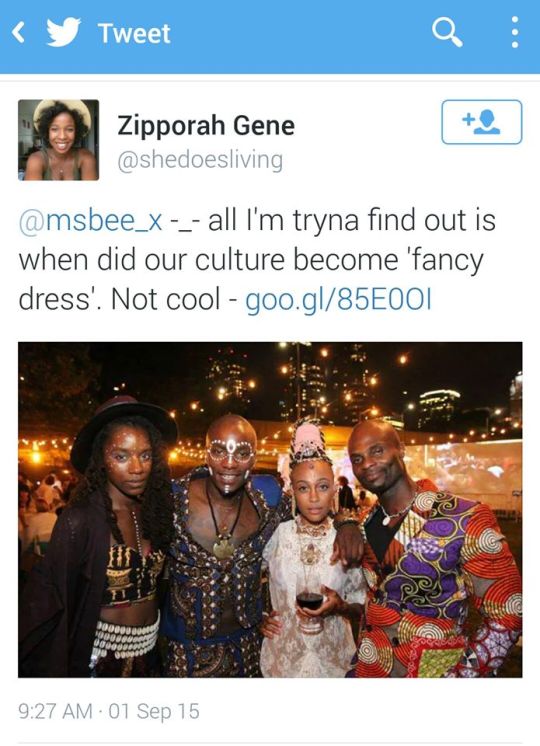
"@msbee_x: all I'm tryna find out is when did our culture become fancy dress. Not cool. goo.g/85E001"
Here's a comment about that photograph from ttps://www.reddit.com/r/blackladies/comments/3kl6ig/funny_story_they_found_the_photo_that_lead/?, submitted by "IrbyTremor ᴛʜᴇ ʙʟᴀᴄᴋ ᴡɪᴛᴄʜ[S], October 2015
"Much as I loathe GodGazi, credit goes where it's due. All are African save for one who is Hatian.
Zipporah is the blogger that wrote that article called “African Americans stop Appropriating African Clothing and Culture.”
This is the photo that drove her to write that stupid blog post. This tweet was written by her on the 1st and her blog was posted on the 3rd. The funny thing about this picture is….everyone in this picture in African clothing is African Continental….not “African American”…lmao.
Young Paris (Milandou Badila) is a world famous musician from the DR Congo.
Ntangou Badila is a famous artist from the DR Congo.
Kwabena Samuel Nana Ofosu-Ware is a world renowned fashion designer from Ghana.
This “reporter” saw a picture taken in Brooklyn and assumed everyone there was born and raised in america…
What’s “Not Cool” is her divisive tactics against African people. You see we are such One People that she couldn’t even tell the difference by sight."
-snip-
Warning: That discussion thread contains profanity.
Note that Young Paris and his sister were raised in the United States, although it's true that they are of Congolese descent.
****
FEATURED VLOG- Are Black Americans Appropriating African Culture?
youngparistv, Published on Sep 30, 2015
Young Paris response to Shedoesliving Article
-snip-
This video is no longer available as of (at least) January 1, 2018
****
TRANSCRIPTION OF THAT VLOG
"Hello everyone. [words in French?] My name is Milandou Badila, also known as Young Paris. And I’m a musical recording artist, creative director, and more recently I founded a brand called “Melanin” which is built around showcasing the beauty and excellence of People of Color.
Um today I want to speak about an article, specifically from a woman that chose to use my image while referencing to what it is for African Americans to appropriate African culture. Um, I’ll start out by saying “To go back to tradition is the first step forward”. I’ll say that again “To go back to tradition is the first step forward”...
Now, to get straight into what you were saying, you started the article by saying “When did our culture become fancy dress ball?” Now I’m gonna give you a little bit of the benefit of the doubt because with the title of the article and why I can understand as an African that it can offend you because when you see so much of appropriation happening throughout different cultures throughout the world, um, and you see something in reference to something that has such a pure base and ambiance to its origins, I understand why you can see something on a platform that looks so fancy and, um, approachable and wonder why, you know, I’m wearing the make-up that I am and different people in the photo wearing these traditions and these patterns, these, um, different dialects of the African Diaspora.
Now, um, I’ll just go in to a little detail about myself because I’m sure that you don’t know who I am. Um my father co-founded the first national ballet of Congo that unified many villages in the Congo and helped educate people with plays and performances and this kinda created a wave of information while Congo was fighting for its independence. So I come from a very strong Diaspora of what it is to be Congolese, what it is to fight for what you believe in, what it is to move forward as an individual and as a culture.
Growing up my father brought that tradition here to us and we carried on this tradition by…you know since I was a baby ..all my ten brothers and sisters were babies..by continuing to perform this traditional drum and dance. So we grew up knowing that we were very different than everyone. It’s like, being me as a kid being African, you know, in a school of African Americans I was always picked on, being laughed at- I’m sure that many Africans can relate. It’s also very interesting to see the type of respect that many Africans get today, which is honorably. But, growing up it wasn’t all the same. So I had to grow up with a lot of different pressures of what it was to be traditional and hold on to these different ideas.
Um, so anyway I going back to say what I represent is very pure and rich to me. I’ll go into a little bit of detail about my face. I’m wearing white because this is what we wear for spirits. And my father died nearly three years ago and in our culture when we wear white to show that we are carrying on the tradition of those that are our ancestors. We also wear yellow which comes from the sun that provides light and energy for us. We wear green that comes from the earth and gives us food. And we wear red for the blood of our people. You usually see me wearing white because my father passed recently and I actually gone through many deaths in the last several years. Un, so again, this just goes back to information and education.
I’m sure you just saw the photo and you saw beautiful people and it threw you off. But one thing I want to ask you as an individual, when you say “our culture” what are you actually talking about? What culture are you stemming from when you say “our culture"? And, you know, coming from someone who has these values and these traditions, you know, when you speak of appropriations, that comment, or that observation comes from someone who feels like their culture or their identity is being appropriated. But, essentially, I don’t know where you come from when you speak on these equations as an African tribal being. So, like, for example, um, if you ever visit different parts of Africa you go to these villages, they’re actually very welcoming. They will be the ones to actually put the paint on you. And they’ll put their garments on you to show you that this is their culture and this is what they find beautiful to them. And it’s just interesting to see how, you know, we’ve gotten to a place where some feel like just because this is sacred to certain people it becomes sacred to them. But you watch how these people receive other people wearing their works or wearing their traditional garments or how they carry on those traditions. You just don’t really have the place to say, you know what your observation is when it comes to this topic because you don’t come from there. So, if anything, those who are being appropriated are the ones who have the opinion because you know, they come from this culture. So, for example, people feel like in music, you know, whether it’s hip hop or jazz or rock, you know you see what many Europeans have done overshadowing the genius of Africans who have created all of these different platforms for people to thrive that don’t come from the culture. But they have the roots and the source to actually speak on this issue because they come from that culture. They live within that culture.
So essentially, if you’re not in these tribes or living in these villages or living in these traditions or practicing what we practice, I don’t understand where your platform [is] [why] you felt the need to say all these different opinions about what we are. Because I feel like at the end of this video I’m not gonna say it super long, at the end of the day when you come from this and it’s real to you, this is you. This is me. This is me every day. Almost every day I wear this paint because I’m always responding to the traditions of my father. I’m always carrying tradition. But if you don’t come from this, I mean, essentially, if you come from this and this is your life, you know what it is to you. You know what it means to you in your heart when you’re praying by yourself in that room and you’re speaking to God or the universe and the energy around you, that’s your relationship.
So it can make you uncomfortable to see people that don’t understand the Diaspora of what it represents but when it’s real to you that’s you.
So there’s nothing you can really remove from me or who I am or what I represent because I live this, every day I live this. I live this weekly. I live this monthly throughout the year to carry on this tradition. To show people and young Africans what it is to feel beautiful, what it is to be an African. Because we already have so many pressures coming from European platforms and supremacy on its own that tells us we can’t be associated with something as rich and pure as back home that is our original ambiance and our original essence as beings. But to be so, to be such a contemporary assimilated being where you feel like, you know, you’re so comfortable in this European Diaspora that you don’t even want those who don’t come from the source of this information to not even show that they… You know they know that they’ve been stolen here as slaves and brought to this other place. But, instinctually, they know that they want to be connected to something that is more rich and realistic to them at, for their life experience. So who are you to remove that from them-to tell them that they can’t relate to something?
Now, one observation, and one objective that I would put up from me coming from this culture that I have been seeing and why it could make me uncomfortable and why I have the place to say this is because I come from it is when people do take, you know, things that are spiritual to certain beings and replenish them and re-showcase them to the public because they feel like it’s beautiful, or they just feel like, you know they’re not very informed and they, to them they just feel like they have a platform to do that. Um, essentially it’s not something that you can really stop because people are going to be inspired because we all are inspired by life. But at the same time I think we, the strongest thing that we can do is educate, and teach people why we do what we do. And then they’ll take the initiative. But again, it goes back to the saying. This is me. This is my life. This is what I’m always going to do so no one can remove that from me.
But again, peace to you Queen. I hope that can find all the well wishes that you desire. Sorry, my face has been cropped for most of this video, but I don’t do vlogs. This is my first vlog ever.
Peace to the public and to everyone who is supportive of me and my family’s journey. We see everything you’re doing and if I still can’t respond to everything you do I still have the love there. Once again this is Milandou Badila also known as Young Paris signing off. And this all stems to say “Educate yourself before you make your opinions". I’m actually glad that you posted this [article] because it brought up a conversation. Thank you to the Yoruba movement and Ngazi and all the other people who have shown love and who have spoken on my behalf, but I feel like it was important for me to just touch base on this and speak to the public a bit. Alright. Peace and love, y’all. Ashe.
-snip-
Transcription by Azizi Powell. Additions and corrections are welcome.
****
Thanks for visiting pancocojams.
Visitor comments are welcome.
Subscribe to:
Posts (Atom)